
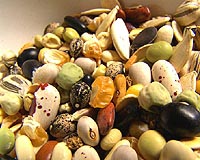
Botanists at Britain's Kew Gardens said Thursday they have collected seeds from 10 percent of the world's wild plants, their first goal in a project to protect all endangered plant species.
Seeds from a wild, pink banana are the latest addition to the collection at Kew's Millennium Seed Bank, designed to guard against dwindling diversity.
The banana from China, musa itinerans, is an important staple for wild elephants and is also useful for breeding new types of the fruit, but is under threat as its jungle habitat is cleared for commercial agriculture.
It became the 24,200th species of wild flowering plant stored in the seed bank, a nine-year-old programme run by the Royal Botanic Gardens at Kew in partnership with institutions in 54 countries.
With it the project reaches its target to collect, bank and conserve seeds from 10 percent of the world's most under-threat wild plant species — although it is already working towards a new goal of 25 percent of plants by 2020.
"The success we are celebrating today is extraordinary and on a scale never before contemplated in global biodiversity conservation," said Professor Stephen Hopper, director of the Royal Botanic Gardens.
"In a time of increasing concern about loss of biodiversity and climate change, Kew's Millennium Seed Bank partnership provides a real message of hope and is a vital resource in an uncertain world.
"The need for the kind of insurance policy and practical conservation resource Kew's Millennium Seed Bank provides has never been greater."
About 60,000-100,000 species of plant are threated with extinction — a quarter of the total — largely because of human behaviour, whether through the clearing or over-exploitation of land or climate change, Kew officials say.
The seed partnership focuses on collecting those plants most at risk — it currently holds seeds from at least 23 species that would otherwise be extinct — and storing them for for future conservation use or research.
Since 2000, more than 3.5 billion seeds have been collected and stored in air-tight containers in the temperature-controlled vaults at Kew's seed bank near Ardingly, southern England, as well as in their countries of origin.
"This is the hub. There is no seed bank like this in the world," Paul Smith, head of the partnership, told AFP.
He said the seeds in the bank would survive for "hundreds, possibly thousands of years".
The first stage of the project cost 73.6 million pounds (120 million dollars, 80 million euros) funded variously from governments around the world and private sponsors, while the next phase will cost about 140 million pounds.
Share This Article With Planet Earth
