
Recession-hit Britain announced 900 million pounds for new helicopters and equipment for the war in Afghanistan Tuesday, but said it would have to close a military base and cut staff to pay for it.
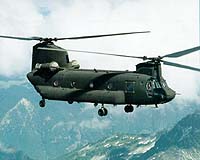
Defence Secretary Bob Ainsworth said the money, worth 1.5 billion dollars or one billion euros over three years, would pay for 22 new Chinook helicopters and equipment including body armour, night vision goggles and tactical radios.
It will come from deep cuts in the rest of the defence budget, which is already being tightened as Britain emerges from recession and struggles to reduce a multi-million-pound deficit built up during the financial crisis.
"These decisions have not been taken lightly but these are tough times for everyone in defence and we must ensure we prioritise spending on operations to achieve success in Afghanistan," Ainsworth said.
The Royal Air Force (RAF) base at Cottesmore, central England, will be closed, as the number of Harrier jets is cut, Ainsworth said.
Two Royal Navy vessels will be withdrawn from service, the Nimrod MR2 spy plane will be withdrawn a year early and the introduction of the latest MRA4 model slowed, while non-essential military personnel will be cut by 2,500.
In addition to the new equipment, Britain will buy an additional C17 heavy lift aircraft for use at home and 22 new Chinook helicopters for frontline troops in Afghanistan, which will start being delivered in 2012/13.
Prime Minister Gordon Brown's government has been accused of underfunding troops in Afghanistan, where 100 personnel have died this year out of 237 since the US-led invasion in 2001, and of failing to provide enough helicopters.
Ainsworth said the new Chinooks, to be bought from US aircraft giant Boeing, would boost Britain's fleet of heavy-lift helicopters from 48 to 70.
"Our forces on the frontline in Afghanistan repeatedly tell me that Chinook are indispensable on operations," he said.
"I am therefore delighted to announce plans to deliver more of these robust, effective and proven battle-winning helicopters."
Brown visited Afghanistan at the weekend to prepare for a London conference next month, at which the US-led coalition hopes to outline its future strategy in Afghanistan.
On his return home, he announced a separate 150-million-pound programme to combat the threat of roadside bombs, which cause the vast majority of troop deaths there.
Share This Article With Planet Earth
