
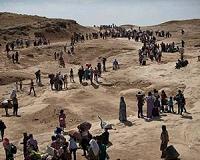
Britain was forced to abort a second airdrop of humanitarian aid to refugees in northern Iraq on Monday because of fears of injuring people on the ground, a military spokesman said.
A fresh attempt will be made within 24 hours to deliver desperately needed food and water to Yazidis stranded on Mount Sinjar after they fled jihadist Islamic State (IS) fighters.
Foreign Secretary Philip Hammond, who chaired a meeting of the government's emergency Cobra committee to discuss the crisis, said the situation was "challenging" and warned of a "potential humanitarian disaster on a huge scale".
But he rebuffed calls from some lawmakers to recall parliament to authorise airstrikes on IS fighters which the US is already carrying out.
Hammond said: "We are providing humanitarian assistance. This is not simple — getting it in is very challenging, getting people off that mountain is even more challenging."
He said the meeting had discussed "obtaining better situational awareness of what's going on on the mountain, both to facilitate the air drops and to start planning how we are going to get people out".
A Royal Air Force (RAF) spokesman said the air crew aborted the drop because they had been afraid of hurting people at the crowded site.
"With a number of people at the drop sites this morning, the crew made the responsible decision not to carry out the air drop to ensure that the lives of those in the area would not be put at risk," he said.
"We plan to deliver the next drop as soon as possible."
Hammond said the plight of the Yazidis was a "potential humanitarian disaster on a huge scale" and it was up to Britain and other countries to help.
Two transport planes left Britain on Saturday and the first drop was made that night, including 1,200 water containers providing 6,000 litres of water, and 240 solar lanterns that double as phone chargers.
Britain has also offered surveillance and refuelling support for US aid flights, but the government says it is not planning to follow the United States' lead and launch airstrikes.
"The American airstrikes are concentrated on protecting Arbil where there is a significant concentration of American personnel," Hammond said.
"We don't envisage a combat role at the present time, we are talking at the moment about a humanitarian operation."
The United States also said on Monday it has begun urgently shipping arms and ammunition to the Iraqi Kurdish forces fighting IS forces.
"We do think it's important that the Iraqi forces, including the Kurdish forces, are able to respond to IS and to tackle this crisis in the country," a spokeswoman for Prime Minister David Cameron's Downing Street office said.
"We will look at what options there are that might enable them to do that. But there have not been substantive discussions on that yet and there are certainly no decisions."
