
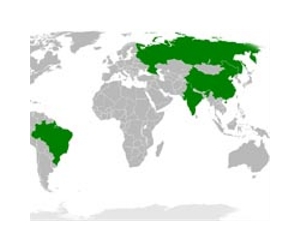
Brazil secured Chinese pledges to investment heavily in and buy more from Brazil as the summit of BRIC countries — Brazil, Russia, India and China — opened a day early to allow for President Hu Jintao to return to China to oversee earthquake relief.
More than 800 people died in an earthquake in western China as Hu embarked on his Latin America visit, which was to have taken him to Venezuela and Chile as well.
The Brazil deal became the highlight of Hu's visit as he cut short his tour.
The wide range of economic collaboration agreed between Brazil and China gives Beijing a much vaunted foothold in Latin America, opening possibilities for business and export expansion, investment in joint projects and military sales.
Analysts said neither of the other two BRIC nations at the summit, India and Russia, could match Beijing in terms of access to cash and extent of business opportunities in a growing consumer market, as in China.
The BRIC summit, the second since last year, looked at alternatives to the U.S. dollar as the world's reserve currency and ways of engineering economic and political shifts to achieve its avowed goal of a multipolar world order — a system independent of Western pre-eminence.
Agreements reached Thursday between Brazil and China include a plan to study the use of the Brazilian real and the Chinese yuan, instead of the U.S. dollar, in bilateral trade.
BRIC countries account for about 40 percent of the world's population.
Analysts said Hu's visit differed from initiatives taken by Russia to boost Latin American trade, including arms sales, because of China's ability to deploy its cash reserves into new acquisitions, investment deals and marketing for a greater share of the region's consumer markets.
Russia has focused on arms sales and technology transfers to increase its cash revenues. Russian deals with Argentina to boost nuclear collaboration will give Moscow a welcome entry into a market that U.S. manufacturers once dominated.
Brazilian Presidents Luiz Inacio Lula da Silva and Hu signed several trade and investment agreements that will see large inflows of Chinese cash into the Brazilian economy.
Lula said a Chinese pledge to build a steel plant in Brazil port would be China's biggest investment ever in Latin America's largest economy.
China may also bid to construct a high-speed train line that will connect Rio de Janeiro with Sao Paulo, he said.
"The possibility for Chinese companies to participate in the modernization of Brazil's infrastructure is exceptional," Lula said, citing the 2014 soccer World Cup and the 2016 Olympics and Beijing's experience as host of the 2008 Olympics.
Details of China's involvement with Brazil's oil industry weren't mentioned but a greater Chinese role in that sector is in the cards because of China's declared strategy of securing energy sources for future growth in its oil demand.
Last year, China agreed on a $10 billion loan facility for Petrobras and more financing for the state-manged oil giant isn't ruled out.
A joint statement said, "The two sides will deepen the bilateral partnership in the oil sector, with the participation of Brazilian companies in development and production in China and the participation of Chinese companies in development and production in Brazil."
Lula and Hu also discussed Iran nuclear issues, on which Lula has frequently expressed support for Tehran. He is due to visit Iran next month.
earlier related report
IMF backs stronger Chinese currency as Asia powers ahead
Washington (AFP) April 21, 2010 –
A stronger yuan is "essential" for both the Chinese and world economies, the IMF said Wednesday as it projected breakneck growth for China and a powerful post-crisis bounce across Asia.
The International Monetary Fund said the Chinese yuan was "substantially" undervalued, heaping more pressure on Beijing to allow the currency to strengthen to help rebalance skewed world trade.
The IMF's latest global report projected that gross domestic product in China, which is set to overhaul Japan this year to become Asia's biggest economy, would rocket by 10 percent in 2010 and 9.9 percent in 2011.
But a yuan adjustment would help China tackle "excess demand pressures," the IMF said in an apparent reference to the threat of rising inflation, and give other emerging economies confidence to let their own currencies strengthen.
"This is essential for China given its large role in the global market," the Washington-based Fund said.
"Greater currency adjustment in Asia would facilitate adjustment in other emerging economies that may fear losing market share if their currencies were to appreciate alone."
The yuan has been effectively pegged to about 6.8 to the dollar since mid-2008. Speculation is growing that Beijing may soon alter its exchange rate policy, as a US-led clamor for change intensifies.
Critics, including a growing number in Asia as well as the United States and Europe, say an undervalued yuan gives Chinese manufacturers an unfair advantage by making their exports cheaper.
As a whole, according to the IMF, Asian economies will expand an average 6.9 percent this year and 7.0 percent in 2011, boosted by both domestic demand and foreign trade.
But it urged regional governments to plan an orderly exit from stimulus policies that helped them weather the global downturn far better than the United States or Europe.
Japan's moribund economy will return to growth of 1.9 percent this year but persistent deflation, weak domestic demand and a stagnant employment picture threaten a fragile recovery, the report said.
Fretting about the risk of contagion from Greece, the IMF cautioned that Japan would in time have to tackle its public debt, which at nearly 200 percent of GDP is the highest in the industrialized world.
India should grow by 8.8 percent this year, the report said, but has "less fiscal room for maneuver" than China and needs to trim its swollen public sector and debt.
Southeast Asia's five biggest developing economies were seen expanding 5.4 percent in 2010.
Australia's resource-driven economy should strengthen 3.0 percent this year, helped by voracious demand for minerals and other commodities to sate Chinese industry's appetite for raw materials.
The IMF's China growth forecast was well above the 8.7 percent growth in 2009 and Beijing's own annual target of eight percent, seen as the minimum needed to create enough jobs in the massive nation to prevent unrest.
Export-led China is seeking to reduce its dependence on overseas shipments and government-backed investment by pumping up domestic spending. The IMF said Asia in general had to shift off its historical dependence on exports.
The Fund cautioned Asian governments against asset bubbles and floods of speculative money that could derail growth, as Western investors seek higher returns and froth builds up in property markets in China and elsewhere.
"For policymakers in Asia's export-driven economies, who now face the prospect of weaker external demand conditions, a key challenge is to effect a durable rebalancing toward domestic sources of growth," it said.
"With regard to monetary policy, it may not be too early to start unwinding the stimulus if output gaps are closing and inflation pressures are beginning to emerge."
Share This Article With Planet Earth
