
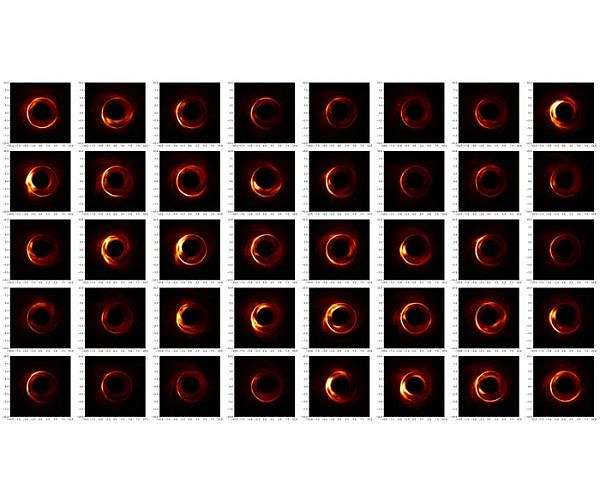
Researchers in China have created a computational model that reveals the dynamic changes in the appearance of rotating regular Hayward black holes over time. Their approach uses a spatio-temporal random field to replicate the turbulent movement of matter around these black holes, producing realistic, time-dependent patterns of light and shadow similar to the changing glow of an accretion disk.
The model accounts for the different paths that light travels around the black hole, generating images that closely resemble those observed by telescopes such as the Event Horizon Telescope. Notably, the simulation shows rotation and shift in the bright ring surrounding the black hole, echoing phenomena recorded in real M87 observations. This behavior develops organically from the spacetime structure and random fluctuations, unlike standard Kerr models, which require fine-tuned plasma settings to produce such effects.
The modeling technique requires considerably less computing power than traditional magnetohydrodynamic simulations, enabling scientists to examine various black hole characteristics, including spin, magnetic charge, and viewing angle, with greater efficiency. This makes the tool valuable for investigating non-Kerr black holes and questioning Einstein's theory in situations of extreme gravity.
Future work will aim to include light polarization and radiative feedback in the simulations. As advanced telescopes like the next-generation Event Horizon Telescope begin to capture black hole evolution in greater detail, models like this will be crucial for interpreting telescope data and exploring black hole physics.
Research Report:Image of a time-dependent rotating regular black hole
