
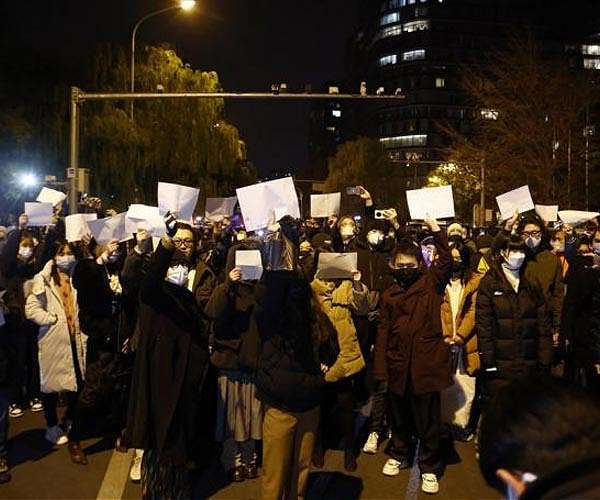
Beijing protesters have been interrogated by police via phone call after attending rare large-scale protests calling for an end to China's harsh zero-Covid controls, one told AFP on Monday.
Hundreds of mostly young people braved icy temperatures to gather near a riverbank in the capital Sunday evening, as a vigil for victims of a deadly apartment blaze in northwestern China's Xinjiang region turned into calls to end zero-Covid.
People have taken to the streets in major cities and gathered at university campuses across China in a wave of protests not seen since pro-democracy rallies in 1989 were crushed.
A woman protester told AFP that by Monday evening she and five of her friends who attended the protest had received phone calls from Beijing police, demanding information about their movements.
In one case, a police officer visited her friend's home after they refused to answer their phone.
"He said my name and asked me whether I went to the Liangma river last night… he asked very specifically how many people were there, what time I went, how I heard about it," she told AFP, asking to stay anonymous for safety reasons.
"The police stressed that last night's protest was an illegal assembly, and if we had demands then we could submit them through the regular channels."
She said that the police officer was mostly "even-toned" during the brief call and urged her not to attend future events.
"I had previously prepared for this, but of course I was still agitated," she said, adding she would "try her best to continue" attending similar protests in the future, and "prepare better" next time.
"I never thought that this kind of civil society activity could ever happen in China," she said.
Two other protesters told AFP they heard that a mutual friend was taken away by police Monday evening, but did not know whether they were summoned for questioning or detained.
It is not clear how police discovered the identities of some protesters and the vast majority of those at Sunday's rally did not have their ID documents checked by police, an AFP journalist saw.
In Shanghai, an AFP reporter witnessed multiple arrests and confirmed that police had forcibly checked one protester's phone for foreign social media apps blocked in China which have been used to spread information about the protests.
On Chinese social media and over encrypted messaging apps inaccessible in China without specialist software, protesters have been sharing tips and legal advice on what to do in case they are interrogated or arrested by police.
UK condemns China for BBC journalist's arrest at Covid demo
London (AFP) Nov 28, 2022 –
Britain's government on Monday condemned Chinese police after the BBC said one of its journalists was arrested and beaten while covering Covid protests in Shanghai, the latest incident to test relations between the countries.
Ed Lawrence, working in China as an accredited journalist, was detained for several hours, during which he was assaulted and kicked by police, according to the UK broadcaster.
After his release, Lawrence tweeted on Monday to thank his followers, adding he believed "at least one local national was arrested after trying to stop the police from beating me".
British Foreign Secretary James Cleverly called the incident "deeply disturbing".
"Media freedom and freedom to protest must be respected. No country is exempt," he tweeted.
"Journalists must be able to do their job without intimidation."
The arrest came as new Prime Minister Rishi Sunak prepared to deliver his first major speech on foreign policy later on Monday, in which he will argue the need to counter UK competitors "not with grand rhetoric but with robust pragmatism".
Some critics took that to mean a softer line on countries such as China, whose diplomats in Manchester earned a relatively mild UK government rebuke after they recently attacked a Hong Kong democracy protester.
Security minister Tom Tugendhat said Lawrence's arrest was "an echo of the repression the CCP (Chinese Communist Party) is attempting elsewhere".
"China's attempts at state repression here in the UK remind us of the urgent need to defend our own freedoms," he said, after reports emerged of China operating undeclared police outposts in foreign countries including Britain.
Hundreds of people took to the streets in China's major cities on Sunday in a rare outpouring of public anger against the state over its zero-Covid policy.
The BBC said it was "extremely concerned", after Lawrence was filmed being hauled away at one of the protests in Shanghai.
"We have had no official explanation or apology from the Chinese authorities, beyond a claim by the officials who later released him that they had arrested him for his own good in case he caught Covid from the crowd," it said.
"We do not consider this a credible explanation."
China's foreign ministry said on Monday that Lawrence had not identified himself as a journalist.
"Based on what we learned from relevant Shanghai authorities, he did not identify himself as a journalist and didn't voluntarily present his press credentials," foreign ministry spokesperson Zhao Lijian said.
He told international media to "follow Chinese laws and regulations while in China".
But the campaign group Reporters Sans Frontieres (Reporters Without Borders) also condemned Lawrence's arrest and alleged assault.
"RSF stands with all those practising fact-based journalism in China & calls on regime to respect their right to report on protests," it tweeted.
