
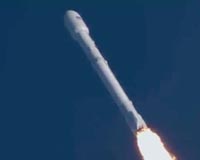
The novel Sun-Synchronous Orbit-A mission (SSO-A) successfully completed on December 3 last year relied significantly on error-free operation of an extensive suite of avionics supplied by Ecliptic Enterprises Corporation (Pasadena, California).
Conceived in 2015 by Spaceflight (Seattle, Washington), SSO-A was the first fully dedicated rideshare mission, where 64 small satellites were integrated onto a single large launch vehicle (a SpaceX Falcon 9) via a modular stack of support structure, launched into Low Earth orbit and then separately deployed from the support structure to become independent Earth-orbiting satellites. This mission set a new U.S. record for the most satellites launched by a single launch vehicle: 64.
Once reaching orbit, avionics on the Falcon 9 rocket's upper stage initiated six deployment events: separation of a large module called the Upper Free-Flyer (UFF), separation of a smaller module called the Lower Free-Flyer (LFF) and release of four small satellites which were attached to a structural module that remined with the second stage.
All of the satellites deployed from the UFF and LFF were of the microsat/CubeSat class-20 on the UFF and 40 on the LFF. Ecliptic's avionics interfaced with five different separation system designs from four different vendors.
The UFF and LFF were both outfitted with a redundant suite of Ecliptic-supplied control avionics, battery packs, radio transmitters and wire harnesses. Separation from the Falcon 9 activated these systems, and for several more hours a combined 60 spacecraft release events were commanded by the electronics, following complex, thoroughly tested event sequences stored in non-volatile memory. Confirmation signals verifying spacecraft release and other important engineering telemetry were also captured and relayed to various tracking stations around the globe.
"Ecliptic's products and services were the key to mission success," wrote Spaceflight's SSO-A Mission Director Jeff Roberts as he commended the firm for its support of the mission.
Ecliptic began its contract with Spaceflight over two years before the launch, stepping through requirements-definition and design phases, build-up of development model test versions of the system, and finally build-up and environmental testing of the flight units.
As part of the overall effort, Ecliptic opened a new wiring harness lab and for over a year and a half designed, fabricated and tested over two miles of test and flight harnesses.
"Programmatically and technically, this was a very challenging effort," said Ecliptic's COO Riki Munakata, who also served as Project Manager for the contract.
"The hardware, software and harnessing designs had to be flexible enough to deal with many changes in the SSO-A payload manifest during the course of the contract, and we knew that the overall operation ultimately had to be flawless for the mission to succeed 100%."
