
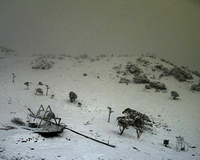
Climate change is threatening to wipe out Australia's critically endangered mountain pygmy possum, but researchers are hoping to save the hibernating species by relocating the last remaining mammals to cooler lowlands.
The tiny mammal lives in alpine regions but less than 2,500 remain in the wild, according to estimates, with winter snowfall declines and warmer weather threatening extinction.
The possums hibernate deep inside humid rock piles that are insulated by snow during winter and provide shelter from high summer temperatures that can prove fatal.
The species — Australia's only hibernating marsupial — needs temperatures to hover just above freezing to hibernate successfully, but without enough snow the cold air outside penetrates the rocks and chills the atmosphere inside, University of New South Wales (UNSW) associate lecturer Hayley Bates said Monday.
"Anything less than 0.6 Celsius will wake them from their hibernation and they can shiver and starve to death," she added.
"You just need two bad winters like this and the species could collapse."
Scientists at UNSW have started a breeding program in a lowland area of New South Wales state in an attempt to acclimatise the possums to a new home, with hopes of establishing an inital colony of 25 animals.
More of the marsupials could be moved from their alpine habitat if the project is successful.
Based on analysis of ancient fossils dating back 25 million years, they believe the mountain pygmy possum's ancestors lived in a more temperate and less extreme environment than it endures today.
Research also showed that other closely related possums had long lived in settings such as lowland rainforests, said UNSW palaeontologist Mike Archer.
"What probably happened is that the modern species followed cool rainforest which invaded the alpine areas during a period of relatively warmer, lush conditions," he added.
"After these conditions deteriorated with further climate change, they were stranded in an environment that was at the extreme end of their adaptability."
The mountain pygmy possum is also under pressure as numbers of its primary post-hibernation food source — the bogong moth — are dwindling, apparently also due to climate change and drought.
If the project is successful, scientists hope other endangered Australian animals could be rescued in a similar way, including the Corroboree frog and the swamp tortoise.
Puffins opt for a lower quality diet when conditions get tough
Washington (UPI) Nov 4, 2019 –
Instead of venturing farther from their breeding grounds in search of a nutritious meal, puffins facing harsh weather conditions prefer to snack on less healthy food items close to home.
Researchers used geolocation loggers to track the movements and dietary habits of Atlantic puffins and razorbills living on the Isle of May National Nature Reserve, off the southeast coast of Scotland.
During the winter of 2014 and 2015, conditions were ideal. Both seabirds mostly ate sandeels of lipid-rich fish. But when conditions worsened in 2007 an 2008, the razorbills ventured farther from their breeding sites to find sandeels, while puffins settled for less nutritious snacks — crustacea, polychaete worms and snake pipefish. Fewer adults returned to the breeding grounds in the year following the harsh winter.
In addition to geotagging the birds, scientists also collected feather samples and tested for chemicals found in jellyfish, which accumulate as it moves up the food chain. Scientists compared the chemical findings with a jellyfish distribution map.
"We still know very little about where some of our commonest seabirds feed and what they eat outside the breeding season. To protect seabird populations within U.K. waters and across the globe, marine spatial plans need to consider not only where seabirds spend the summer but also where they are in the winter months," Katie St. John Glew, postdoctoral researcher at the University of Southampton in Britain, said in a news release. "This information is critical for assessing vulnerabilities of seabird species to climatic and environmental change and for designing effective management strategies for these species."
Authors of the new study, published recently in the journal Movement Ecology, suggest their analysis methods could be used to track where and what other marine species are eating. Researchers hope the study will inform conservation efforts for the puffin and other vulnerable seabirds.
"Numbers of many seabird species are already declining," said Sarah Wanless, an ecology professor at Southampton. "Given the increasing threats from climate change and human activities such as fishing, microplastics and offshore windfarms, identifying ways to protect and conserve seabirds when they are at sea are urgently needed."
