
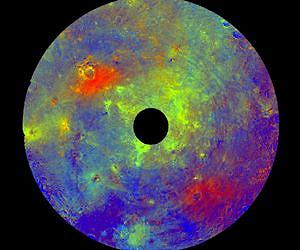
This image using color data obtained by the framing camera aboard NASA's Dawn spacecraft shows Vesta's southern hemisphere in color, centered on the Rheasilvia formation.
Rheasilvia is an impact basin measured at about 290 miles (467 kilometers) in diameter with a central mound reaching about 14 miles (23 kilometers) high.
The black hole in the middle is data that have been omitted due to the angle between the sun, Vesta and the spacecraft.
Scientists assigned different colors for the ratios of two wavelengths of radiation detected by the framing camera to indicate areas that are relatively redder or bluer.
The red indicates wavelengths at 750 nanometers divided by 440 nanometers.
Blue indicates areas at 440 nanometers divided by 750 nanometers. Scientists are still studying why certain areas look redder or bluer.
Green indicates areas at 750 nanometers divided by 920 nanometers, suggesting the presence of the iron-rich mineral pyroxene or large-sized particles.
This mosaic was assembled using images obtained during Dawn's approach to Vesta, at a resolution of 480 meters per pixel.
