
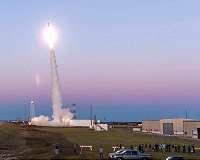
A NASA Black Brant IX sounding rocket carrying a parachute test platform was successfully launched at 6:45 a.m. EST, October 4, from the agency's Wallops Flight Facility in Virginia.
The 58-foot tall rocket carried the Advanced Supersonic Parachute Inflation Research Experiment (ASPIRE) from NASA's Jet Propulsion Laboratory in Pasadena, Calif. The mission is to evaluate the performance of the ASPIRE payload, which is designed to test parachute systems in a low-density, supersonic environment.
The flight was conducted through NASA's Space Mission Directorate.
The payload flew to an altitude of approximately 31.62 miles and then landed in the Atlantic Ocean. The payload is being recovered for data retrieval and inspection.
NASA's Sounding Rocket Program is conducted at the agency's Wallops Flight Facility. Orbital ATK provides mission planning, engineering services and field operations through the NASA Sounding Rocket Operations Contract. NASA's Heliophysics Division manages the sounding-rocket program for the agency.
The next launch currently scheduled from Wallops is Orbital ATK's Antares rocket carrying the Cygnus spacecraft with supplies and experiments to the International Space Station. Antares is scheduled for launch no earlier than November 10.
New Zealand opens first rocket launch site
New Zealand Economic Development Minister Steven Joyce on Wednesday opened New Zealand's first orbital launch site, Rocket Lab Launch Complex 1, on the Mahia Peninsula on the North Island's east coast.
Joyce congratulated Rocket Lab's chief executive and founder Peter Beck and his team "who have worked hard to achieve this," saying in a statement that "it is their innovation and perseveran … read more
