
Around 2.2 billion people worldwide, over a quarter of the global population, lack access to clean, safely managed drinking water. Nearly half of the world's population faces severe water shortages at least once annually. Addressing these challenges involves significant socioeconomic investments in wastewater irrigation, rainwater reuse, and seawater desalination. Centralized water distribution systems, however, often fail to quickly adapt to changes in demand, sparking growing interest in decentralized water production technologies.
Key options include electrochemical techniques such as capacitive deionization and battery electrode deionization (also called faradaic deionization). A limitation of these technologies has been their reliance on water quality sensors that estimate overall conditions based on electrical conductivity, without tracking individual ions.
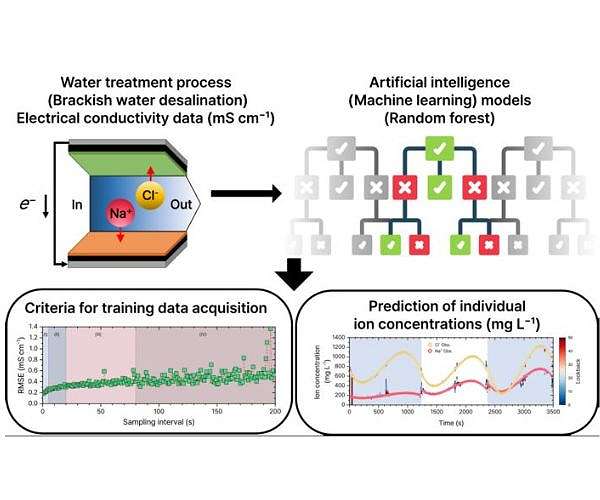
A research team led by Dr. Son Moon from the Korea Institute of Science and Technology (KIST) Water Resource Cycle Research Center, collaborating with Professor Baek Sang-Soo from Yeongnam University, has developed an AI-driven approach to precisely predict ion concentrations in electrochemical water treatment processes.
The team employed a random forest model-a machine learning technique commonly used for regression-to forecast ion concentrations during electrochemical water treatment. The AI model accurately predicted the electrical conductivity of treated water as well as concentrations of key ions, such as sodium (Na+), potassium (K+), calcium (Ca2+), and chloride (Cl-) with a high degree of precision (R=~0.9).
To maintain accuracy, the model requires updates every 20-80 seconds, meaning that in a national water quality network, water quality measurements would need to be taken at least every minute. The researchers noted that this random forest model requires far fewer computational resources compared to more complex deep learning methods, making it an economically attractive solution.
"The significance of this research is not only in developing a new AI model, but also in its application to the national water quality management system," said Dr. Son Moon. "With this technology, the concentration of individual ions can be monitored more precisely, contributing to the improvement of social water welfare."
