
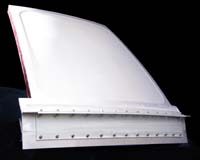
As part of the Alliant Techsystems-led team and its risk reduction efforts focused on the Ares I upper stage production proposal, Lockheed Martin has completed fabrication of two common bulkhead demonstration articles. Team Ares led by ATK includes major subcontractors Lockheed Martin, and Pratt and Whitney Rocketdyne, Inc.
Each company has initiated specific activities for early research and development, and each promises to reduce the technical risk for Ares I, while also providing a practical application and benefit to a variety of other programs across the individual companies.
Internal funds are being utilized to build demonstration models, perform testing, and conduct data analyses. These three activities are:
+ Demonstration of manufacturing techniques for the common bulkhead
+ Composite impact damage detection and assessment
+ Reaction control system development
Lockheed Martin has invested in a demonstration of the manufacturing techniques required to fabricate a common bulkhead that separates the fuel and oxidizer compartments of a propellant tank. Lockheed Martin leveraged its experience in designing and manufacturing high-performance lightweight space structures to build the demonstration article.
The demonstration articles represent a portion of a full spherical dome assembly. Two test articles measuring 4 feet by 4 feet with a 9-foot radius of curvature and using phenolic resin honeycomb sandwiched between thin gage aluminum face sheets were fabricated. The first was representative of NASA's Ares I Upper Stage design, and the other incorporated an alternate Lockheed Martin design more focused on producibility.
In building the demonstration article, Lockheed Martin utilized manufacturing processes that it has validated in recent years. Conventional Friction Stir Welding of thin gage alloys joined the face sheets to y-chord sections, and engineers demonstrated Self-Reacting Friction Stir Welding as a method for providing the structural joint between the forward and aft y-chord sections. Phased Array Ultrasonic inspection was used to evaluate weld quality.
Shearography was demonstrated as an applicable inspection technique for ensuring the quality of the honeycomb to the face sheets bonds.
Tomo-lithographic molding processes were demonstrated as an alternative method for fabricating honeycomb. Each of the critical processes was demonstrated in an environment that focused on meeting stringent human-rated requirements in a cost effective and reliable manner.
"Our goal is to leverage Lockheed Martin's core competencies in mitigating development risk for future launch vehicles in NASA's Constellation Program," said Ron Wetmore, Lockheed Martin vice president, Shuttle Derived Launch Vehicles.
"One obvious way to accomplish this objective is to develop and implement technologies that reduce manufacturing risks associated with hardware such as the common bulkhead."
"The specific risk mitigation activities we're conducting that will benefit NASA's Ares Upper Stage are also of interest to the core capabilities of our companies as well as other customers," said Jim Halsell, ATK vice president and Team Ares program manager, Ares I Upper Stage.
"We are taking steps today in order to provide NASA with data that could lead to the early retirement of program risk for many applications."
