
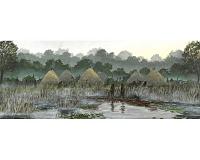
Human remains from the Late Mesolithic era — a period just prior to the introduction of farming — are nearly nonexistent in Britain.
The outlier, however, is Oronsay, a small island in the Inner Hebrides. Recently, a team of archaeologists determined a previously unidentified collection of bone fragments to be the remains of Britain's last hunter-gatherers.
Researchers were able to confirm the bones' age and human origin by analyzing the bone collagen, proteins collected from the fragments.
The discovery challenges the narrative of the transition from hunting and gathering to agriculture. The bone fragments suggest the switch didn't happen as quickly as previously thought, and that hunter-gatherers with heavily marine-based diets may have held onto traditional survival strategies even as farming became the norm farther inland.
"Analyzing previously unidentified bone fragments shows us that both hunter-gatherer-fisher and farming lifestyles potentially co-existed on the West coast of Scotland for several hundred years," Sophy Charlton, research associate at the Natural History Museum in London, said in a news release. "Further analysis has the potential to greatly clarify our understanding of the transition to agriculture in Western Scotland and more broadly across Britain."
Scientists detailed the results of their collagen analysis in a new paper, published this week in the Journal of Archaeological Science.
"Our findings also illustrate how information can be obtained from previously overlooked material," added Charlton, lead author of the new study. "So much research potential lies dormant within 'unidentifiable' prehistoric bone fragments, and there is consequently significant potential for the future application of this method to other prehistoric sites."
