
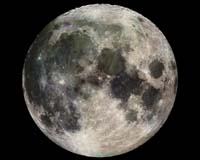
Scientists at the Air Force/Navy High Frequency Active Auroral Research Program (HAARP) in Alaska and the Long Wavelength Array (LWA) in New Mexico back in October, 2007 received what is believed to be the lowest frequency RF echo off the lunar surface.
They are set to best that this weekend with yet another lunar echo experiment, and they are asking help from Amateur Radio operators the world over to tune in.
In the previous experiment they utilized the LWA to receive the signals bounced off the moon. In the experiment which begins January 19th at 0500 UTC, HAARP scientists are asking Amateur Radio operators to listen in and send signal reports as to what they hear, or do not hear whatever the case may be.
They concur that Hams equipped with a simple 40-meter dipole and basic HF radio should be able to receive the signal.
The test will be ran January 19th on 6.7925 MHz from 0500-0600 UTC, and on 7.4075 MHz from 0600-0700 UTC. It will once again be ran January 20th on 6.7925 MHz from 0630-0730 UTC, and on 7.4075 MHz from 0730-0830 UTC.
In the previous lunar echo experiment (more properly called a lunar bistatic radar experiment) conducted on Oct. 28 and 29, 2007, the HAARP high power transmitter, located near Gakona, Alaska, launched high power radio waves toward the moon. The reflected signal, weakened because of the long distance to the moon and back, was detected by receiving antennas in New Mexico.
HAARP's full total power capability, about 3.6 MW, was used to transmit pulses two seconds in length every five seconds over a period of two hours each day, one hour at each frequency.
Using such a pulse pattern makes the echo, which arrives back from the moon 2.4 seconds later, immediately recognizable, allowing the scientists to distinguish the moon's echo signal from the HAARP signal. This same pattern will be used in this weekend's experiment.
