
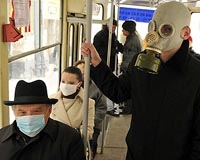
Ukraine's epidemic of flu and acute respiratory disorders has now affected more than a million people, the country's deputy health minister said on Tuesday.
Vasyl Lazoryshynets said the death toll from the epidemic had risen to 174, as President Viktor Yushchenko warned the country must brace itself for a second wave of infections.
Nearly 53,000 Ukrainians have now been hospitalised, Lazoryshynets said, but the number in intensive care has fallen by nearly a quarter to around 330.
A total of 67 cases of swine flu have been reported in Ukraine, he said, 14 of which had been fatal.
"Ukraine must prepare properly for a second wave of respiratory infections and flu," including A(H1N1), Yushchenko said Tuesday, according to the Interfax news agency.
A World Health Organisation (WHO) team in Ukraine said on Monday the epidemic had slowed, but warned a second wave was likely.
On Monday the health ministry's previous bulletin on the epidemic, which began in mid-October, reported 969,000 infections, with 155 deaths and 65 cases of A(H1N1).
earlier related report
US sick leave policy toughens swine flu fight: senator
Washington (AFP) Nov 10, 2009 –
Swine flu is causing "an American emergency" as employees who lack paid sick leave go to work despite being ill and spread the disease, US lawmakers were told Tuesday.
The A(H1N1) virus "is causing an emergency for workers and families across the country," Senator Chris Dodd told a Senate subcommittee hearing on paid sick leave in a time of pandemic flu.
The United States is the only developed nation without a national policy on paid sick leave, Dodd said.
Most government workers, including US legislators, have paid sick leave, but since it is not mandatory some 57 million US private sector workers, including many in low-paid jobs and tens of thousands working in school systems, lack the benefit.
For them, contracting the swine flu "means you have a choice: either go into work sick and risk infecting your co-workers or stay home and lose a day's pay," Dodd said.
The senator has introduced legislation to give US workers paid sick days if they or a family member come down with swine flu.
As the nation struggles to emerge from a punishing recession and double-digit unemployment, many Americans cannot consider taking unpaid sick leave, said Dodd.
"We're in the company — and I say this respectfully of these countries — of Lesotho, Liberia, Papua-New Guinea and Swaziland. Those countries and the United States are the five that don't have paid sick leave," Dodd said.
"Five nations, four of whom are struggling economies, barely surviving as nation-states, and the richest country in the world," he told a hearing in the Senate health, education, labor and pensions subcommittee.
A person who goes into work when they have swine flu will infect 10 percent of their co-workers, according to data from the Centers for Disease Control and Prevention (CDC), which has repeatedly urged people to stay at home if they fall ill with flu-like symptoms.
"If paid sick leave had been a reality when this pandemic began, we would be in better shape," Dodd said.
The A(H1N1) flu has infected as many as 5.7 million people in 48 US states and claimed 672 lives, including at least 129 children, according to CDC data.
Share This Article With Planet Earth
