The spacecraft is Voyager 1, and the answer is a canister of slowly decaying plutonium. It left Cape Canaveral on 5 September 1977 and is now about 171 times as far from Earth as the Sun is, still returning data on two instruments. The radio signal it sends home is radiated by a transmitter putting out roughly 22 watts — less than the incandescent bulb in a hallway — and it now takes close to 24 hours to arrive. On 18 November 2026, at 2:16:07 a.m. Pacific time, NASA calculates the probe will be 16,094,799,096 miles from Earth — one light-day, the first human-made object ever to reach that distance, and the point at which a hello and its answer take 48 hours.
It still works because of three specific things: a nuclear power source that decays slowly and predictably, a 1970s command architecture stripped down to almost nothing, and a flight team at NASA’s Jet Propulsion Laboratory that has spent years switching hardware off one piece at a time to buy more. On 17 April 2026, engineers shut down the Low-energy Charged Particles experiment, leaving the magnetometer and the plasma wave subsystem as the only two instruments still doing science. The signal delay grew for the simplest reason there is: the probe kept moving, outward, at about 17 kilometres a second, into a region no other spacecraft has mapped.
A nuclear battery the size of a filing cabinet
Voyager 1 does not have solar panels. Beyond Jupiter, sunlight is too weak to run a scientific spacecraft, so the probe carries three radioisotope thermoelectric generators, or RTGs, mounted on a boom that swings out from the main bus. Each is packed with pellets of plutonium-238 dioxide. As the plutonium decays it releases heat, and thermocouples convert that heat directly into electricity — solid-state devices with no moving parts to wear out.
At launch the three generators produced about 470 watts between them. The half-life of plutonium-238 is roughly 88 years, so most of the fuel is still there; what has degraded faster is thermocouple efficiency. Together those two curves cost the spacecraft about four watts every year, which Suzanne Dodd, the Voyager project manager at JPL, has framed as the price of keeping a pair of “deep space rock stars” alive. Alan Cummings, a Voyager co-investigator at Caltech, told an audience in 2024 that each probe now has something like 230 watts to work with. Nearly half a century in, roughly half the original output is gone.
That same physics — heavy nuclei releasing enormous energy from very little matter — is what makes nuclear fuel dense enough to run either a fission reactor or an interplanetary probe. The industry’s standard comparison holds that a single uranium fuel pellet the size of a fingertip carries the energy of a tonne of coal. Voyager’s plutonium pellets are a different isotope doing a different job, but the underlying reason a spacecraft can run for fifty years on a canister of ceramic is the same.
The lineage runs back to a Berlin bench in December 1938, when Otto Hahn and Fritz Strassmann found barium in a neutron-irradiated uranium sample and Lise Meitner, writing from exile in Sweden, worked out what it meant. A splitting uranium-235 nucleus releases about 200 million electron volts, some 50 million times what you get from burning a single carbon atom. Voyager’s generators are a quieter cousin of that discovery — not fission but alpha decay, harnessed for spaceflight in a way that would have seemed like fantasy to any of the three of them.
Why the signal now takes nearly a full day
Radio waves travel at the speed of light. Everything else about the delay is geometry. Voyager 1 crossed the heliopause — the boundary where the Sun’s solar wind gives way to interstellar plasma — in August 2012, and it has kept going ever since. Each astronomical unit it adds costs a little over eight minutes each way, close to seventeen minutes on the round trip.
At roughly 171 astronomical units, light needs something like 23 hours and 45 minutes to cover the distance one way. In November the gap becomes exactly a day. What that means operationally is best put the way Dodd has put it: a command sent on a Monday morning gets its answer back on Wednesday morning. Not the next day. The day after that.
The consequence is a flight team working permanently in the past tense. If something goes wrong aboard the spacecraft, nobody on Earth learns of it for almost a full day, and by the time a fix arrives another day has gone. Every decision is made about a machine whose current condition is unknowable.
Why 22 watts is enough to be heard
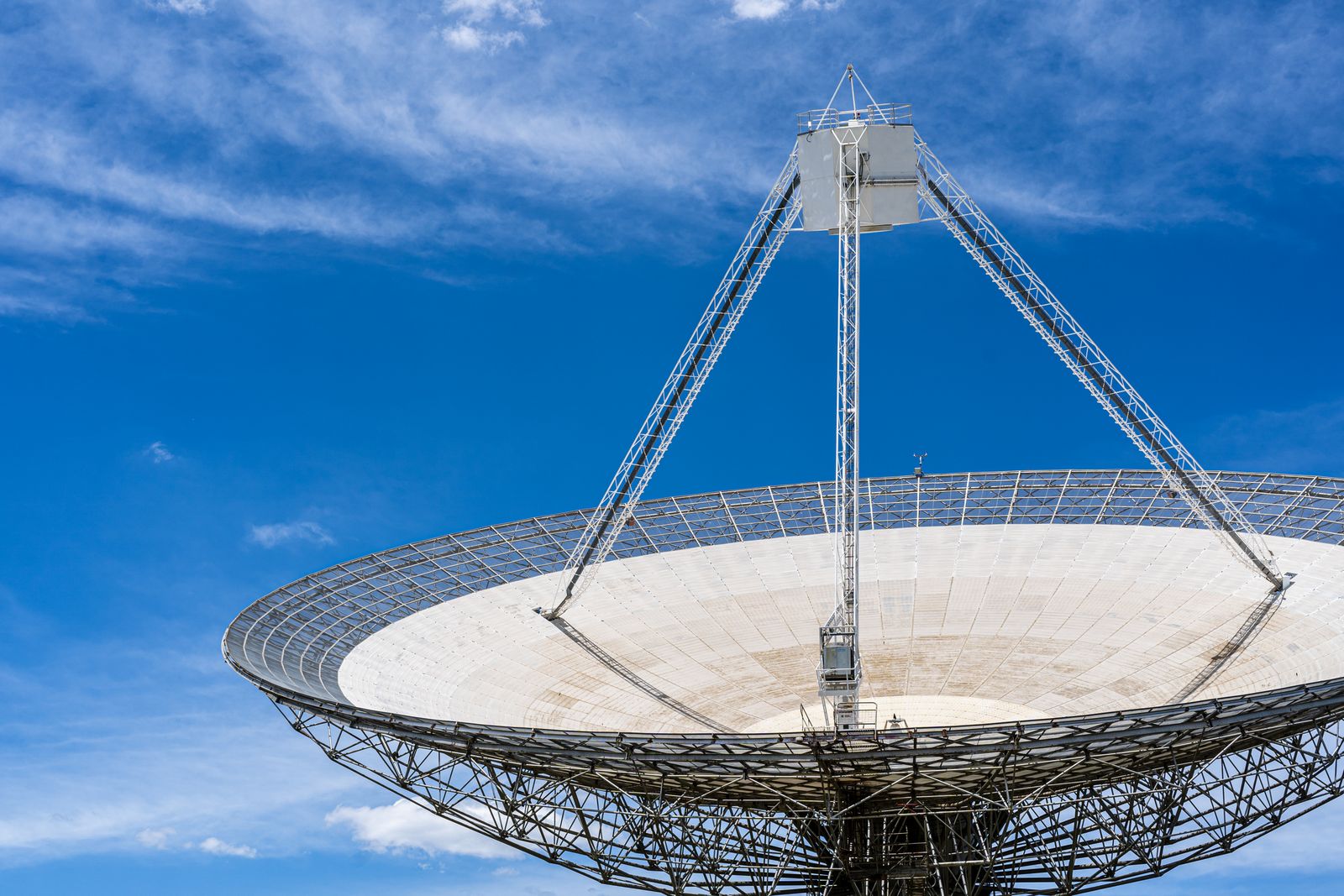
A typical incandescent hallway bulb draws 40 to 60 watts. A modern LED equivalent draws six to nine. Voyager 1’s transmitter radiates about 22.4 watts toward Earth, and the Deep Space Network’s 70-metre dishes in California, Spain and Australia pull that whisper out of the cosmic background from nearly 16 billion miles away, at 160 bits per second — dial-up speed, from interstellar space.
By the time the signal reaches the ground its power has fallen to something on the order of 10⁻¹⁸ watts, a billionth of a billionth of a watt. The receivers recover it through decades-refined error correction and the sheer collecting area of the dishes. The physics is absurdly favourable in one respect: radio waves in a vacuum lose nothing to absorption. They only spread out.
Twenty-two watts is the radiated signal, though, not the spacecraft’s budget. Running the radio is the single most expensive thing Voyager does. “It takes about 200 watts, approximately, to run the transmitter on the spacecraft,” Dodd told Space.com, in the same conversation in which she put the remaining margin on each probe at five or six watts. That is the arithmetic the whole mission now lives inside: a couple of hundred watts of demand, a couple of hundred watts of supply, and four watts a year draining out of the gap.
An 8-track tape recorder and 69 kilobytes of memory
The computers aboard Voyager 1 predate the personal computer. The Computer Command Subsystem, the Flight Data Subsystem and the Attitude and Articulation Control Subsystem carry about 69 kilobytes of memory between them — less than a single photograph on a modern phone. Data that cannot be sent immediately goes onto a Digital Tape Recorder, an 8-track machine descended from consumer audio hardware of the 1970s.
That antique architecture is part of why the mission has lasted. The instructions are simple. The hardware runs cold and slow. There are no operating-system updates, no background processes, no memory leaks. When a command arrives, the spacecraft does exactly what it says.
The trade-off is that the flight team has to know the machine in extraordinary detail, and much of the knowledge has aged out. Many of the original engineers have retired or died. Documentation lives in binders scanned from typewritten pages. In November 2023, when Voyager 1 began returning unreadable telemetry, the team spent five months reverse-engineering their predecessors’ work before tracing the fault to a single failed memory chip in the Flight Data Subsystem — then relocated the affected code elsewhere in memory and had the spacecraft talking sense again by 2024.
Nothing about that repair was routine, and every step of it was taken across a delay that has since grown longer. The team wrote a patch, sent it, and waited nearly two days to find out whether they had killed the mission.
The Big Bang
The bigger fix is a manoeuvre JPL has nicknamed the Big Bang: switching off three devices that have kept the thruster fuel lines from freezing and switching on three lower-power alternatives that do the same job for almost ten watts less. Ten watts, on a spacecraft with single-digit margin, is enormous — enough to postpone the next instrument shutdown by at least a year.
The stakes are unusually blunt. The fuel lines must stay warm. If they freeze, the probe loses attitude control, the high-gain antenna drifts off Earth, and the mission ends — not with a bang but with silence. So engineers tried it on Voyager 2 first, which is closer to Earth and has slightly more power to spare. It worked: NASA announced on 4 August 2026 that the swap succeeded, keeping Voyager 2’s three instruments running at least a year longer than planned. The same procedure is now scheduled for Voyager 1 in the coming months.
Every shutdown before it was a negotiation between science and survival. The Low-energy Charged Particles experiment had run almost continuously since 1977, measuring ions and electrons streaming through the interstellar medium and mapping pressure fronts no other instrument can reach. Turning it off closed a window on a region nothing else has ever sampled directly. Without shutdowns like it, Dodd’s team has said, the probes would have had only months of power left before end of mission.
But they did not quite kill it. Engineers left the instrument’s stepper motor running, because it draws only half a watt and because leaving it on preserves the chance of switching the experiment back on if the Big Bang frees up enough power. Stamatios Krimigis, the instrument’s principal investigator at the Johns Hopkins Applied Physics Laboratory, wrote to CNN that “the stepper has worked flawlessly for nearly 49 years and over 8.5 million steps” — and kept stepping even after its heater was switched off and its temperature fell to −62°C.
What Voyager is still measuring, and what happens when it stops
The two surviving instruments are the magnetometer and the plasma wave subsystem. Between them they map the magnetic field of the local interstellar medium and register the density of charged particles around the spacecraft — a direct probe of the frontier between the Sun’s influence and the rest of the galaxy.
That frontier is now being surveyed from the opposite direction. NASA’s Interstellar Mapping and Acceleration Probe launched in September 2025, reached the first Sun–Earth Lagrange point in January 2026, and began its primary science mission on 1 February 2026, charting the heliosphere’s boundaries from a million miles from Earth. Voyager measures the wall by touch. IMAP photographs it from inside.
The heliosphere is not a sphere. It is a lopsided bubble carved out of the interstellar medium by the solar wind, with a blunt nose in the direction the Sun is travelling through the galaxy and a long tail behind. Voyager 1 punched through the nose. Voyager 2 crossed in November 2018 at a different angle, giving physicists two puncture points in a wall tens of billions of kilometres across.
Everything else aboard Voyager 1 — the tape recorder, the ancient computers, the fuel lines that must not freeze — is a consequence of the power budget. The generators are the boundary condition. Sometime in the 2030s, if the engineering holds, the last science instrument will go dark. For a while after that the spacecraft will still send engineering telemetry, a carrier tone and a few housekeeping numbers, until even that stops. Then the transmitter will fall silent and the probe will keep going.
There is nothing to slow it down. In about 40,000 years Voyager 1 will pass within 1.6 light-years of Gliese 445, a red dwarf presently in the constellation Camelopardalis, still carrying the Golden Record — a gold-plated copper disc with greetings in 55 languages, whale song, Bach and Chuck Berry — bolted to its flank, unread and probably unreadable, at a temperature a few degrees above absolute zero.
By then the plutonium will be effectively gone and the 22-watt transmitter will have been quiet for tens of thousands of years. But the aluminium bus, the boom, the dish and the record will still be moving at 17 kilometres a second, in the direction they were pointed on a late-summer morning in Florida in 1977, when some of the engineers who now run the mission had not yet been born.