
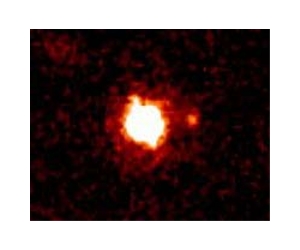
TAOS II will measure the size distribution of small objects (~1 km diameter) at the edge of our solar system in the Kuiper Belt and beyond.
These objects are of scientific interest because they provide important information on the formation and dynamic evolution of the Solar System. TAOS II will operate three medium sized telescopes at the Observatorio Astronomico Nacional (OAN) at San Pedro Martir (SPM) in Baja California, Mexico.
Each telescope will be equipped with a custom high-speed camera capable of collecting image data on more than 10,000 stars simultaneously, at a readout rate of 20 Hz. The resulting data volume will be enormous, with over 300 terabytes per year of raw image data.
These three telescopes will each have a 150 mm diameter focal plane that is equipped with ten 8.8M pixel e2v CMOS (active pixel sensor) devices that will be custom designed, manufactured and backthinned by e2v to provide very low read-noise (competitive to CCD sensors) and high spectral response.
The 31 x 74 mm sensors will operate at 20 frames per second (a rate not possible with this size of CCD) to detect the fraction of a second when a Kuiper belt object passes in front of a distant star and the photometric light dips.
These very distant solar system objects are rarely studied because they are so small and faint, making it impossible to detect them directly.
Paul Jorden, Technical Specialist at e2v said "The imaging sensors for TAOS-II will establish a new performance baseline for astronomical imaging enabled by e2v's world leading design and production capabilities for state-of-the-art CMOS technology. These sensors have the size and sensitivity of CCDs combined with high frame rate operation."
Paul Ho, the director of ASIAA said "TAOS II is a major initiative at the ASIAA to work at the frontier of time-domain astrophysics, and solar system exploration.
The new CMOS sensor technology from e2v enables fast and sensitive astronomical observations over a large focal area. This opens up a new research field for fast time variable science in Astronomy. We are looking forward to working with these devices and deploying them on our new telescopes at San Pedro de Martir."
