
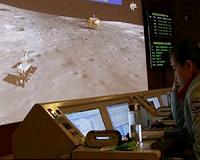
After a considerable delay and some highly vague statements, China has indicated that the Yutu Moon rover is transmitting telemetry to Earth. This is a highly encouraging development, as it suggests that all is not lost for the embattled robot. It also counteracts earlier speculation by analysts (including this writer) that Yutu was completely dead.
Yutu experienced problems shortly before the onset of a two-week lunar night when one of its solar panels failed to retract. The panel was designed to insulate the rover's interior from the cold, and contain heat from a radioisotope power source inside the rover's body. It was widely expected that the extreme cold of the Moon would cause the rover to totally fail.
A few days after the sun rose at the landing site, that still seemed to be the case. Yutu seemed to be silent. Now, it seems that the rover has woken from its slumber.
Right now, we still don't know what is working on Yutu and what is not. It seems that the Chinese themselves are still not sure. It will probably take days for them to slowly and meticulously test the machine.
Let's consider what we know. If it is transmitting, then the batteries, communications gear and computers should be working reasonably well. This is a very good start. It is also probable that the rover will still have mobility. The wheels and associated gear were designed to be exposed to the lunar night and were not affected by the solar panel mishap.
So, it can transmit and it can probably drive. But can it do any work?
Some of the scientific instruments could still be functional, but it remains to be seen if they can still work well enough to produce trustworthy data. In any case, navigating the rover could be difficult if there is no camera to see the terrain. Chinese scientists could elect to drive the rover by dead reckoning, and guess its rough location.
Photography from NASA's Lunar Reconnaissance Orbiter, which has already spotted Yutu, could even be used to help navigate the vehicle. This could require some cautious negotiations, and possibly involve NASA publishing open-access imagery online. If the Chinese download the images like everyone else, so be it!
