
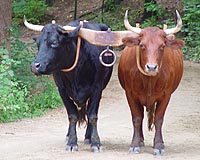
South Africa's Chinese community welcomed the Year of the Ox with feisty lion dances and ear-thumping firecrackers, but the 2009 Lunar New Year holds a deeper significance beyond festivities.
Monday marks the first new year since Chinese South Africans were classified black in a landmark ruling that recognised they had suffered racial inequality under the country's former white rule.
For the small community, it was a long overdue recognition.
"We feel part of one country now, we don't feel excluded at all," said Edwin Pon, a fourth generation South African and chairman of the 100-odd year old Gauteng Chinese Association.
"We have an identity. We've finally been recognised as South African."
With hundreds of people packed into downtown Johannesburg's small Chinatown for traditional dragon and lion dances, food and fireworks on Sunday, the revelry symbolised more than the Ox's sign of prosperity through hard work.
"You could feel the atmosphere especially among the local Chinese that we definitely felt like we were part of South Africa," said Pon, 34, whose organisation hosted the celebrations in rainy weather.
"Now we can finally say we are part of everybody now — that even though we are Chinese we can celebrate our culture and be South African."
The court ruling meant that Chinese — like black, mixed race and Indian South Africans — are eligible for benefits meant to tackle economic imbalances inherited from apartheid.
Chinese were left out of the new laws despite having been classified as mixed race under apartheid and subject to forced evictions, not being allowed to vote, and banned from having sexual relationships with whites.
"The decision fortified me and cleansed some nasty memories of my youth. It was cathartic," said Ernie Lai King, the head of tax at a large South African law firm.
For Pon, the ruling also helped ease the pain of slurs of "ching chong chinaman" in his childhood, and feeling on the sidelines of both other local communities and that of a growing group of new Chinese arrivals.
"Seeing so many non-Chinese coming to our function is a truly fantastic occasion, he said, "we are part of this rainbow nation truly now."
The court ruling applies only to South Africans of ethnic Chinese descent who were citizens before the end of white rule in 1994, a small group numbering some 10,000 people of the country's population of 48 million.
A wave of Chinese arrivals in democratic South Africa, who have formed a bustling Chinatown in east Johannesburg, do not qualify for the benefits which include affirmative action job preference and business opportunities.
But in multi-racial South Africa, where apartheid's injustices have yet to be eradicated, the judgment caused a backlash when handed down last June.
"Many black people did not like the ruling. They felt that Chinese did not 'deserve' that status," said empowerment consultant Gavin Levenstein.
"I think at this moment the ruling has been accepted by most. On the other side, the Chinese population is relatively small," he added.
Lai King admits the post-ruling "venom and racism" had been a physical blow, with historical facts and logic proving little in the face of raw emotion. But support received had also been emotionally uplifting, he said.
Since then, interest in the issue has died down and there had been little impact business-wise in the small community.
"The ruling was in my opinion more a moral victory for an 'invisible' community and about recognition of the inequalities imposed upon us during apartheid," Lai King told AFP.
"Our invisible and silent community just needed someone to affirm this."
Share This Article With Planet Earth
