
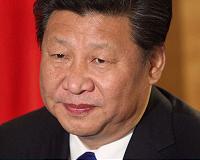
President Xi Jinping warned Saturday that China was facing a "grave" situation as authorities took more drastic steps to halt the spread of a virus that has killed 41 people and is overwhelming hospitals at the epicentre of the health emergency.
The world's most populous country scrambled to contain the disease that has already infected nearly 1,300 people, building a second field hospital to relieve overwhelmed medical facilities and closing more travel routes as the country marked the Lunar New Year holiday.
After more countries reported cases, Xi said at a Communist Party leadership meeting on the disease that China was "faced with the grave situation of an accelerating spread of the new coronavirus" but that the country will "definitely be able to win the battle," according to state media.
The country's most important celebration has been all but cancelled for at least 56 million people as authorities expanded travel bans across central Hubei province to try and contain the spread of the virus.
In Wuhan, the epicentre of the emergency, 450 military medics were deployed to help treat patients in Hubei's capital city, where a seafood and live animal market has been identified as the centre of the outbreak.
On Saturday, when they should have been celebrating the New Year, people waiting at one hospital in the city were angry and frustrated.
"It takes at least five hours to see a doctor," one woman, who didn't want to be named, told AFP.
One man in his 30s said some people had to queue for two days. Many people had brought their own chairs for the wait.
Wuhan authorities will race to build the second makeshift hospital within a fortnight, state media reported, adding 1,300 new beds.
They already started work Friday on a new field hospital, which state media said could be ready in just over a week.
The two hospitals would be similar in size to the temporary facility that was built to tackle SARS in Beijing in 2003, when 650 people died from the disease in the mainland and Hong Kong.
The army medics, who arrived on military aircraft late Friday, include doctors with experience combating SARS or Ebola and will be dispatched to hospitals that are reportedly short on beds due to a crush of infected patients and worried locals.
The virus has caused global concern because of its similarity to SARS (Severe Acute Respiratory Syndrome).
The new virus has now infected people nationwide and in nearly a dozen other countries, with France saying three cases were confirmed there — the first known European infections.
– 'Nobody can leave' –
On the eastern outskirts of Wuhan, Hubei's capital, police manning a roadblock turned away a handful of vehicles trying to exit the city.
"Nobody can leave," an officer told AFP.
But the police allowed some medical workers who had gone home for the holidays to re-enter the city to help at crowded hospitals.
"They need us to go there, otherwise they will be too exhausted," said one of the women, pulling a suitcase.
Trapped residents were stocking up on masks, gloves and disinfectant while car traffic will be severely restricted from Sunday.
The city has a shortage of medical supplies including goggles and masks, according to the official Xinhua news agency, which added that the government has shipped 14,000 protective suits and 110,000 pairs of gloves to Wuhan.
"Everyone is just trying to protect themselves," said a man in a surgical mask at a busy pharmacy whose staff wore protective suits.
Foreign citizens were set to be evacuated from Wuhan within the next few days.
US Coffee chain Starbucks said it would shut all its stores in Hubei during the Lunar New Year festival for the "health safety" of staff and customers.
The government says most of the cases have been in Hubei and most of the deaths involved people who already suffered pre-existing health conditions.
Underscoring fears that the virus could spread further, overseas Chinese tour groups will be suspended from Monday while domestic trips have already been halted.
Beijing will suspend long-distance bus service entering and leaving the capital of 20 million people from Sunday due to "requirements of epidemic prevention and control," the official People's Daily newspaper reported.
The National Health Commission also ordered nationwide measures to detect and isolate people carrying the virus on planes, trains and buses across the country.
Xinhua said Saturday that temperature screening checkpoints have been set up in 387 railway stations across the country.
Meanwhile, tourists from Hubei in Haikou, capital of the island province of Hainan, were told by the city government they had to spend 14 days in a hotel for centralised medical observation, and were forbidden to leave.
– Hong Kong schools close –
Beijing's Forbidden City, Shanghai Disneyland and a section of the Great Wall are among many attractions that have closed as a precaution. China's film box-office earnings for Lunar New Year's Eve on Friday were just one-tenth of last year as people shunned crowds.
Xi chaired a Communist Party leadership meeting which urged regional governments to make "the safety of the masses' lives and their physical health a top priority", state media said.
Xinhua said the Standing Committee agreed to set up a working group that would visit Hubei.
In Hong Kong, where five people have tested positive for the virus so far, city leader Carrie Lam declared the situation an "emergency" and schools, currently on holiday, will remain closed until February 17.
The World Health Organization on Thursday stopped short of declaring a global emergency, which would have prompted greater international cooperation, including possible trade and travel restrictions.
The global spread of the coronavirus: Where is it?
Beijing (AFP) Jan 25, 2020 –
A SARS-like virus that has claimed 41 lives since emerging in a market in the Chinese city of Wuhan has spread around the world.
Here are the places that have confirmed cases of 2019 Novel Coronavirus:
– China –
As of Saturday, almost 1,300 people have been infected across China, the bulk of them in and around Wuhan.
Nearly all of those who died were in the Wuhan region, but officials have confirmed two deaths elsewhere.
The city of Macau, a gambling hub hugely popular with mainland tourists, has confirmed two cases.
In Hong Kong, five people are known to have the disease. Three of those cases were confirmed in the 24 hours to Saturday morning.
– France –
There are three known cases of the coronavirus in France, the first European country to be affected by the outbreak.
One person is sick in Bordeaux and another is ill in Paris. A third person, who is a close relative of one of the other two, has also been confirmed to have the virus.
All three had recently travelled to China and had now been placed in isolation.
– Japan –
Japan's health authorities confirmed the country's third case on Saturday.
One man was hospitalised on January 10, four days after his return from a visit to Wuhan.
Two people from the Chinese city — a man in his 40s and a woman in her 30s — have been treated in hospital for fever.
– Australia –
Australia on Saturday confirmed its first case of the virus, a man who arrived in Melbourne from China a week ago.
Authorities said they were contacting people who had travelled on the same plane from China and offering advice.
– Malaysia –
Malaysia confirmed its first three cases on Saturday. All are Chinese nationals on holiday from Wuhan who arrived in the country from Singapore two days earlier.
A 66-year-old woman and two boys, aged two and 11, are in a stable condition and are being kept in an isolation ward at a public hospital, Malaysia's health minister said.
– Nepal –
Nepal said a 32-year-old man arriving from Wuhan had the deadly disease.
The patient, who was initially quarantined, recovered and was discharged. The government said that surveillance has been increased at the airport "and suspicious patients entering Nepal are being monitored".
– Singapore –
Singapore has announced at least three cases — a 66-year-old man and his 37-year-old son, who arrived in Singapore on Monday from Wuhan, and a 52-year-old Wuhan woman, who arrived in the city-state on Tuesday.
– South Korea –
South Korea confirmed its second case of the virus on Friday.
The health ministry said a South Korean man in his 50s started experiencing symptoms while working in Wuhan on Jan 10. He was tested after his return earlier this week, and the virus was confirmed.
The country reported its first case on January 20 — a 35-year-old woman who flew in from Wuhan.
Both remain in treatment and are in stable conditions.
– Taiwan –
Taiwan has uncovered three cases so far. It has since advised against travel to Wuhan and Hubei province and on Friday said any arrivals from Wuhan would be rejected by immigration.
All arrivals from the rest of China — including Hong Kong and Macau — must fill out health declaration forms on arrival.
It has also banned the export of face masks for a month to ensure domestic supplies.
– Thailand –
Thailand has detected five cases so far — four Chinese nationals from Wuhan and a 73-year-old Thai woman who came back from the Chinese city this month.
Two of the Chinese patients were treated, and have since recovered and travelled back to China, the Thai health ministry said this week.
– United States –
On Tuesday US health officials announced the country's first case, a man in his 30s living near Seattle. On Friday a second case was announced — a woman in her 60s living in Chicago.
Both were treated and are recovering.
– Vietnam –
Vietnam confirmed two cases of the virus on Thursday. An infected man from Wuhan travelled to Ho Chi Minh City earlier this month and passed the virus on to his son.
Both are being treated in hospital and are stable, Vietnam health officials said.
