
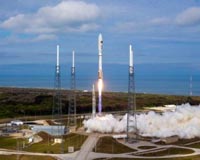
The launch of the fourth X-37B mission has not resolved some of the biggest mysteries that surround this flight, and the X-37B program in general. X-37B is a robot mini-shuttle launched by the US Air Force on semi-secret missions that last for months or well over a year.
It was a surprise to be openly informed of two payloads on this latest launch. The X-37B is testing an electric Hall Effect thruster in its small payload bay, which will be used on future US Air Force satellites. It is also carrying small material samples for NASA, which are being tested for their exposure to outer space. The Air Force has never discussed the payloads carried on previous missions, and we are still no closer to finding out.
Curiously, we do not know which X-37B is being used on this flight. We were openly told about the particular model in the past. So why not now? For the record, two X-37B spaceplanes have flown before. One made the first and third flights.
A second vehicle made the second mission. Is either of these vehicles being used now? We don't know. It seems strange not to be told about this, especially when the Air Force is being so open about other aspects of the mission. Cloaking details that were previously considered open while releasing other details that were formerly classified is perplexing.
We also have no photos of the latest vehicle on the US Air Force Web site. This contrasts sharply with previous missions, where clear images of the spacecraft were released before launch.
This suggests that there could be something different about the X-37B spaceplane itself. Is it modified from previous launches? Has it been massively overhauled? Are parts being interchanged between previously flown vehicles? We can only speculate.
This analyst will suggest that there could be something physically different on the exterior of the spacecraft, and that this would be observable in photography. What could it be? One possibility is an infrared camera mounted on one or both of the spacecraft's tailfins. A similar experiment was once flown on the Space Shuttle, and provided data on thermal loads during re-entry. So far, we do not believe that this has been carried out in the X-37B program. It could be time for such an experiment to fly.
How long will the mission stay up? NASA partially let the cat out of the bag when it disclosed a minimum 200-day limit for the flight in a media release. The Air Force has said nothing. We really don't know, but this analyst expects that the mission will fly considerably longer than 200 days.
We know about the Hall Effect thruster and the NASA materials samples in the payload bay. But is there anything else? Curiously, we have been told about the payloads but shown no images. Even NASA has not released images of its own payload before installation in the spacecraft. Could this suggest that there are other payloads that we don't know about?
Clearly, the X-37B program is still good at keeping secrets. We should expect this to continue for quite some time.
