
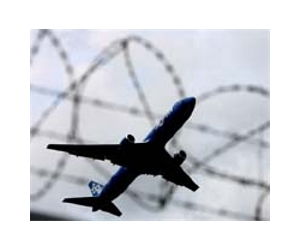
In a major row developing within the European Union, lawmakers are opposing a decision by EU interior and justice ministers who agreed to a U.S. request to boost air travel security.
The ministers Thursday at a meeting in Spain decided to by April come up with proposals to improve passenger screenings at airports, security on board of U.S.-bound planes and data sharing.
EU ministers might even try to introduce the controversial body scanners and air marshals on board passenger planes, as is the practice on selected flights in the United States.
The decision was sparked by U.S. demands for tighter security after a man with links to al-Qaida tried to detonate a bomb on a Detroit-bound passenger plane arriving from Amsterdam in the Netherlands.
Yet lawmakers from the European Parliament voiced their opposition within hours after the announcement.
"It will be very difficult for the European Council to get a majority in Parliament for this proposal," Manfred Weber, deputy head of the Christian Democratic faction of the European Parliament, told the Financial Times Germany newspaper.
The European Parliament has in the past opposed several attempts for international security cooperation in what it says is a bid to safeguard human rights and civil liberties.
For the past few months it has voiced its opposition to the Swift agreement, which gives the United States access to bank data of millions of Europeans.
Both propositions could be voted down by the Parliament, which has greater powers thanks to the Lisbon Treaty, the EU's institutional reform that came into effect last year.
The row over the Swift agreement has also been heating up recently.
Parliament officials have repeatedly called on Brussels to delay the coming into effect of Swift until the Parliament can vote on it. The council wants to speed up the process so that the agreement can't be blocked. Experts say lawmakers would likely decide against Swift, which gives the United States access to some 15 million bank transactions each day.
Air travel security cooperation with the EU was boosted in 2007, providing U.S. prosecutors greater information about passengers arriving from Europe. Body scanners are used in Britain and the Netherlands.
Earlier this week the Munich airport was temporarily shut down after a laptop search triggered a bomb alarm, causing the owner of the computer to flee. The man is still at large.
Share This Article With Planet Earth
