
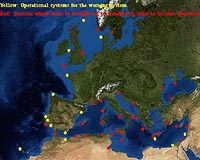
A system to provide a 15-minute tsunami alert for the West Mediterranean is on track for startup in the first half of 2012, French officials said on Friday.
The system's heart will be based at a site of France's Atomic Energy Commission (CEA) at Bruyeres-le-Chatel, about 40 kilometres (25 miles) south of Paris.
Computers there will analyse data sent in real time from seismic sensors and wave gauges dotted around the coastline of France, Italy, Spain, Morocco, Algeria and Tunisia.
If the software's conclusions match calculations by seismologists on a round-the-clock watch, France will issue a warning about coastlines at risk.
The goal is to issue an alert within 15 minutes of a tsunami-generating earthquake — a very short time lapse compared with the Pacific because of the speed with which a giant wave could cross the Mediterranean.
A tsunami generated by a quake occurring near Algeria — one of the hot spots — would take only 30 minutes to reach the Spanish holiday island of Majorca.
The warning will be received by national authorities, which must then pass on the alert at local level. One plan is to send automatic text messages, or SMSes, that would be received by mobile phones in areas that could be hit.
"Fifteen minutes — that's going to be a technical challenge and a human challenge," Bruno Feignier, head of analysis, surveillance and environment at the CEA, said during a visit by journalists escorting France's junior ecology minister, Chantal Jouannot.
The network will also cover part of France's Atlantic coastline.
Relatively few tsunamis have occurred in the Mediterranean and east Atlantic, where earthquakes are relatively rare and slow-moving compared with the massive quakes that take place in the Pacific.
Records point to five in the western part of the Mediterranean in the past six centuries — in Algeria in 1365, 1856 and 2003, in Italy in 1887 and in Sicily in 1908.
In the east, a quake at the western tip of Crete in 365 AD generated a wave that devastated Alexandria, at the mouth of the Nile.
The Portuguese capital of Lisbon, meanwhile, was destroyed in 1755 by an earthquake and tsunami unleashed by movement in the eastern Atlantic on a faultline running between the African and Eurasian tectonic plates.
A warning system for the Mediterranean is one of the links in an initiative, launched after the Indian Ocean tsunami of December 2004 that claimed a quarter-million lives, to set up up monitoring networks for all the major seas.
Italy will cover the central Mediterranean, Greece the eastern Mediterranean and Aegean Sea and Turkey the sea of Marmora and the Black Sea, while Portugal will cover the Northeast Atlantic.
France's CEA has been chosen for the task as it has decades of experience in seismic monitoring. It listens out for underground nuclear explosions, for tsunami-generating earthquakes that could threaten France Polynesia and for quakes that occur in metropolitan France.
Share This Article With Planet Earth
