
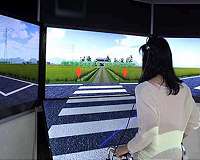
Despite its narrow streets, high proportion of car ownership, and dense population, Japan routinely ranks as one of the world leaders in traffic safety. Simulators are part of the reason why; the Japanese keep practicing safety until they get it right.
Safety simulator maker Akita Precisions Industry Co. (API) can take some of the credit for the success. Based in Akita Prefecture in Japan's north, the 34-year old firm has found a strong market for its computer graphics and story-based learning machines over the past 15 years of their development.
API's marquee product is its "Watari Jozu-kun," a simulator which mimics pedestrian movement in potentially unsafe environments that include motorized vehicles. The machine takes up the area of a small room with three screens facing the viewer. The participant begins the simulation by facing the central screen while standing on a sensor-laden rubber pad with handrails on either side.
He or she assumes a normal walking gait to calibrate the machine while remaining in place. The walking motion is translated into virtual steps on the screen. Once the settings are complete, the course begins.
Oncoming traffic appears on the left and right hand sides of the viewer in the form of cars, trucks, and motorcycles moving at various speeds and frequencies. Volunteers anxious to try the machine were typically struck – sometimes killed – by vehicles within several seconds after attempting to cross a virtual crosswalk.
"The machine's degree of danger and difficulty is adjustable, depending on the main point of instruction," says API technician Akihiko Ito, smiling wryly. Mr. Ito introduced the simulator at a Tokyo virtual reality fair to a cadre of interested onlookers. He notes that pedestrians typically succumb to two mistakes: 1) not making themselves reasonably visible to traffic, and 2) not checking both directions frequently enough to notice oncoming vehicles.
"The machine is designed to raise awareness that just because vehicles typically stop for people and traffic lights, they don't always do so," he says. "It only takes one miscalculation on either side to cause a fatality."
The machine can also be adjusted for adverse weather conditions and for varying levels of visibility.
API's simulators have experienced commercial success; at 4 million yen per copy, 78 prefectural police departments and government offices across Japan employ them. They are currently available only domestically, Mr. Ito says.
The machines' effectiveness may at least partially explain some safety statistics. Despite ranking 16th highest in car ownership per capita and 40th in population density, Japan ranked 168th in traffic-related deaths at just 3.28 persons per 100,000 population in 2015, according to data sources.
That put Japan one notch above the U.K., at 2.97 persons. Iran (43.54), Iraq (41.41), and Venezuela (41.06) topped the list as the most dangerous countries, while China (18.49) ranked 77th, and the U.S. (9.99) came in at No. 131.
Overall, the total number of road traffic deaths worldwide has plateaued at about 1.25 million per year, despite the rapidly escalating number of motor vehicles worldwide – a good sign. But the highest fatality rates continue to occur in low income countries, according to the World Health Organization (WHO). Pedestrians, cyclists and motorcyclists account for 49% of the number.
WHO found that while 92 countries have policies to promote walking and cycling in order to foster better health and combat problems such as obesity, road traffic injuries could trend upward if these strategies are not accompanied by other measures such as effective speed management and the provision of pedestrian and cycling safely measures.
