
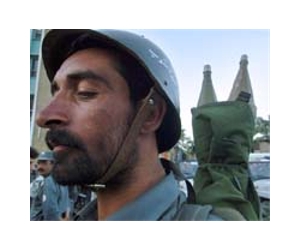
Insurgents led by an Uzbek militant group attacked an Afghan police station killing one policeman, with two militants later killed in a NATO air strike, officials said Sunday.
The insurgents attacked Ali Abad district police headquarters in the northern province of Kunduz late Saturday, district chief Haseebullah Mohtasham told AFP.
"One policeman was killed in the attack," he said.
NATO said coalition troops fired on the militants' truck from the air, leaving two militants dead and wounding several others.
NATO said the attack was led by a commander of the Islamic Movement of Uzbekistan (IMU), a group known to attack Afghan security forces.
It said the group also channelled weapons to insurgents in another troubled district in the area.
Northern Afghanistan has been relatively peaceful compared to the insurgency heartlands in the south, but this year militants have stepped up attacks in some northern border provinces including Kunduz.
The IMU, created in 1998 and opposed to the government of President Islam Karimov in Uzbekistan, carved out bases in the north of Afghanistan under the Taliban 1996-2001 regime.
The United states branded IMU a terror organisation in 2000 and the Uzbeks were forced out of Afghanistan by the US-led invasion in late 2001, but are believed to remain in border areas of Pakistan's tribal belt.
related report
Kurdish rebels declare truce during Ramadan
The PKK Kurdish rebel group declared Friday a temporary truce during the holy month of Ramadan in their campaign against Turkey's armed forces, the press agency Firat news said.
"We announce having moved from the position of active defence that we have observed since June 1 to a position of passive defence," the outlawed Kurdistan Workers' Party (PKK) said in a statement quoted by the pro-Kurdish news agency.
"From August 13 to September 20 our forces will not undertake any action, but will use their right to defend themselves in case of attack against them or the population," the rebel group said.
The ceasefire covers Ramadan when Muslims fast from dawn to dusk and strive to be more pious and charitable.
It will also coincide with a referendum on September 12, when Turks will vote on a reform of the constitution aimed at democratising Turkish institutions.
The PKK have denounced the proposed reform as an "initiative without the sincere will to create a truly democratic constitution."
The Kurdish rebel group has called for the constitution to recognise the rights of some 15 million (out of a population of 73 million) Turkish Kurds, as well as grant autonomy to the east and south east regions in Anatolia.
The PKK, listed as a terrorist group by Turkey and much of the international community, took up arms for self-rule in the Kurdish-majority southeast in 1984, sparking a conflict that has claimed around 45,000 lives.
It has significantly stepped up attacks since its jailed leader Abdullah Ocalan declared in May that he was abandoning efforts to seek dialogue with Ankara.
related report
NATO admits five Afghan civilians killed in air strike
NATO acknowledged on Sunday that five Afghan civilians appeared to have been killed by one of its air strikes, carried out to help fend off a Taliban attack in the south of the country.
The incident occurred on Thursday in Lashkar Gah district of Helmand province when members of the NATO-led International Security Assistance Force (ISAF) came under fire from insurgents and called in aircraft "to provide supporting fire," ISAF said in a statement.
"Later that day, four wounded and three dead Afghan civilians were brought to a nearby check point, where two of the wounded died. The remaining two wounded were immediately evacuated to an ISAF medical facility."
While investigations are ongoing, "there is evidence civilians were in the compound targeted by coalition forces during the operation.
"We regret this tragic loss of life. Our first objective is to protect the people of Afghanistan and in this case we may have failed," the statement said.
Last year then-head of US and international forces in Afghanistan, General Stanley McChrystal, imposed restrictions on the use of air strikes, leading to a sharp drop in such unintended killings in the first half of this year, according to a recent United Nations report.
The new head of international forces, General David Petraeus, also issued a directive at the beginning of the month on avoiding civilian casualties.
However, a UN report issued on August 10 said the number of civilian casualties in the war had risen by a third in the first six months of this year, reaching 1,271 deaths, with insurgents killing seven times more civilians than NATO-led troops.
Share This Article With Planet Earth
