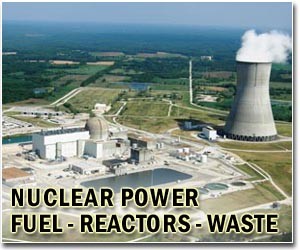
A debate has begun as the U.S. nuclear industry turns up the power on old reactors, creating worry over the safety of pushing aging equipment beyond its limits.
The practice, known as uprating, is coming under scrutiny in the wake of Japan's Fukushima Daiichi nuclear crisis, the Los Angeles Times reported Sunday.
Uprating is accomplished by using more potent fuel rods in a reactor core to generate more heat to create steam to drive electricity-generating turbines.
Twenty of the nation's 104 reactors have undergone these "extended power uprates" since the U.S. Nuclear Regulatory Commission began approving such boosts, some as much as 20 percent, in 1998.
Nuclear watchdogs and the U.S. Nuclear Regulatory Commission's own safety advisory panel have expressed concern over these large upratings.
"This trend is, in principle, detrimental to the stability characteristics of the reactor, inasmuch as it increases the probability of instability events and increases the severity of such events, if they were to occur," the Advisory Committee on Reactor Safeguards, which has a Congressional mandate to advise the NRC, has warned.
Critics of uprating point to unforeseen accident scenarios such as those experienced in Japan.
"It's beyond the wit of mankind to identify all challenges to a nuclear plant," said John Large, a former researcher for the British atomic energy agency who runs a consulting company in London specializing in nuclear safety.
Share This Article With Planet Earth