
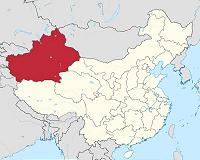
An Uighur refugee living in Belgium complained Tuesday that Chinese authorities had cracked down on his family after they applied for the right to join him.
Abdulhamid Tursun's case has raised controversy in Belgium, where rights groups accuse the Belgian authorities of having effectively "delivered up" his relatives to the Chinese.
In May, Tursun's wife and four children visited the Belgian embassy in Beijing to seek visas to join him, but left after they were told they must first have Chinese passports.
Now they are back in their home in Urumqi, Xinjiang, and under what the refugee, now living in Ghent, said was increasing official pressure from a government that has cracked down on Uighurs.
"They are at home, under surveillance, and don't have the right to leave without authorisation," the 51-year-old told AFP in Brussels.
He is able to talk to his wife via the WeChat messenger app, but says the couple self-censor their conversations, which they assume are monitored.
"The Chinese government has still not given them the passports they need to leave the country," he said, urging Brussels to pressure Beijing.
Tursun has had asylum, under the name Ablimit Tursun, in Belgium since 2017 but human rights defenders are concerned about his family, and accuse Belgium of having cast them aside.
The foreign ministry insists there was a simple misunderstanding after Belgian diplomats urged the family not to stage a sit in on embassy premises.
But before the wife and children can be issued travel documents, China must print them passports, and there is no sign that Beijing is in a hurry to do so.
"She can't speak on the telephone because the conversations are bugged, that's for sure. She edits her feelings," he told AFP. "I can tell that she's frightened, frightened for the children."
Rights groups say the Uighurs, a mainly Muslim minority, have suffered a severe crackdown that has seen millions interned in re-education camps whose existence China denied until recently.
Uighur jailed in China wins top European rights award
Strasbourg, France (AFP) Sept 30, 2019 –
A Uighur scholar imprisoned in China since 2014 was jointly awarded a top European human rights prize on Monday, an accolade likely to draw the ire of Beijing.
Ilham Tohti, 49, is serving a life sentence on charges of separatism for advocating the rights of Uighurs, a Muslim minority in the northwestern Xinjiang region of China.
The Vaclav Havel Human Rights Prize, named after the Czech ex-president, dissident and writer, was awarded by the Parliamentary Assembly of the Council of Europe (PACE) to Tohti and the Youth Initiative for Human Rights (YIHR), a group created in 2003 to help foster postwar reconciliation in the Balkans.
Rights groups say the Uighurs have suffered a severe crackdown that has seen millions interned in re-education camps whose existence China denied until recently.
Earlier this month, the prosecutor's office in Xinjiang said one in five arrests made in China in 2017 took place in the region, even though it represents just two percent of the country's population.
Beijing had already slammed the PACE last month for nominating Tohti for the Vaclav Havel prize, saying it was effectively "supporting terrorism".
"Today's prize honours one person, but it also recognises a whole population in giving the entire Uighur people a voice," said Enver Can of the Ilham Tohti Initiative, which received the award on Tohti's behalf, according to a Twitter post by the PACE.
The YIHR's prize was accepted by Ivan Djuric of YIHR Serbia, who warned about the growing danger from a resurgence in nationalist parties and policies in a region where ethnic divisions have often flared into violence.
"Don't play deaf to the sound of war drums from the Balkans… "We're not strangers, we're Europeans," the council tweeted, quoting Djuric.
Liliane Maury Pasquier, president of the Parliamentary Assembly of the Council of Europe, said on Twitter, "In honouring them (both prize winners), we also send a message of hope to the millions of people they represent and for whom they work: human rights have no frontiers."
