
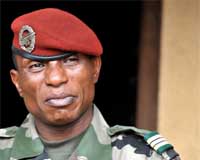
Washington has imposed new sanctions on Guinea's military junta, barring entry to the United States to some of its members, in the wake of last month's massacre of opposition supporters, the State Department said Thursday.
"The United States imposed restrictions on travel to the United States by certain members of the military junta and the government, as well as other individuals who support policies or actions that undermine the restoration of democracy and the rule of law in Guinea," spokesman Ian Kelly said.
The sanctions went into effect on October 23, he added in a statement.
"The citizens of Guinea deserve the right to choose their own leaders after decades of authoritarian rule," Kelly said.
"The military junta in power has shown itself disrespectful of human rights and incapable of shepherding Guinea through a peaceful transition to democracy," he added.
Kelly's announcement coincides with an African Union decision Thursday to also impose visa and travel restrictions on members of Guinea's junta, led by Captain Moussa Dadis Camara.
On October 14, the United States had called on Camara to step down. Shortly after the junta seized power in the mineral-rich state on December 23, 2008, Washington suspended its foreign aid to the country.
The new sanctions follow a violent September 28 incident in Guinea, when junta troops opened fire at a rally in a Conakry stadium organized to pressure Camara not to stand in presidential elections planned for January.
At least 150 people died, according to the United Nations. Human rights groups put the toll at 157 dead and more than 1,200 injured, including women who were publicly raped.
The military regime has admitted that 56 people died and 934 were wounded.
The US and African Union sanctions are the latest in a string of punitive measures to be taken against the junta.
On Tuesday the European Union said it was imposing an arms embargo, asset freeze and travel bans on junta leaders.
The Economic Community of West African States (ECOWAS) also imposed an arms embargo earlier this month.
The United Nations has already announced it would set up an inquiry into the massacre while the International Criminal Court said it will hold a separate preliminary inquiry to determine if war crimes had been committed.
African Union slaps sanctions on Guinea junta
African leaders on Thursday imposed a new barrage of sanctions Guinea's military rulers, increasingly under fire in the wake of last month's massacre of scores of opposition supporters.
Heads of states who sit on the African Union Peace and Security Council decided to "to take all the necessary measures towards the implementation of targeted sanctions including denial of visas, travel restrictions and freezing of assets," a statement said.
The sanctions will target junta leader Captain Moussa Dadis Camara "as well as members of the government and any of the civilian or military persons whose activities are aimed at maintaining the unconstitutional status quo in Guinea," the statement said.
"The sanctions will enter into force immediately," said the head of the AU peace and security commission, Ramtane Lamamra.
A list of persons targeted by the sanctions is to be sent to the United Nations, the Arab League, the Organisation of Islamic Conference and a grouping of French-speaking countries in order to give the measures "a universal character", said the statement.
The decision comes a month after junta troops opened fire at a rally in a Conakry stadium urging Camara not to stand in presidential elections planned for January.
At least 150 people died, the United Nations says. Human rights groups put the toll at 157 dead and more than 1,200 injured, including women who were publicly raped.
The miliatry regime has admitted that 56 people died and 934 were wounded.
The junta seized power in the mineral-rich state on 23 December last year, just hours after the death of Guinea's longserving ruler Lansana Conte, who was an autocratic army general.
The African Union sanctions are the latest in a string of punitive measures to be taken against the junta.
On Tuesday the European Union said it was imposing an arms embargo, assets freezes and travel bans on junta leaders.
The Economic Community of West African States (ECOWAS) also imposed an arms embargo earlier this month.
The United Nations has already announced it would set up an inquiry into the massacre while the International Criminal Court said it will hold a separate preliminary inquiry to determine if war crimes had been committed.
The junta has so far refused to ease its grip on power, but has pledged to work with a regional mediator — Burkina Faso's President Blaise Compaore.
Next Monday, the Guinean opposition is due to meet Compaore in Ouagadougou for talks about the political crisis.
The opposition has refused to talk to the junta until the army quits power, and has proposed forming a new government of national unity to pave the way for elections.
Share This Article With Planet Earth
