
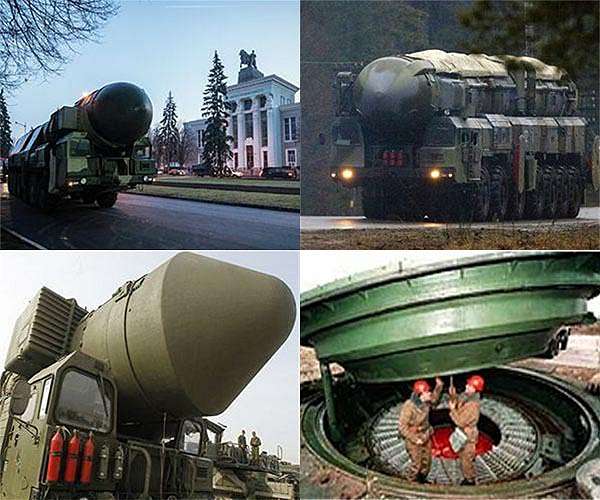
The United States condemned Russian President Vladimir Putin's nuclear forces alert Sunday, and said his conventional ground forces were experiencing logistical problems in their invasion of Ukraine.
US officials said Putin's stunning announcement, four days after his powerful military launched an assault on Ukraine, was dangerously escalatory and part of a pattern of fabricating excuses to justify aggression.
Putin said he took the action in response to "aggressive" and "unfriendly" actions by NATO and Western countries, as the Ukraine crisis deepened.
"This is a pattern that we've seen from President Putin through the course of this conflict, which is manufacturing threats that don't exist in order to justify further aggression," White House press secretary Jen Psaki said on ABC.
A senior US defense official, speaking on grounds of anonymity, said Putin's step came as Ukraine's forces, helped by arms from the West, continued to stymie the advance of Russian troops, who this official said had run into fuel supply and other logistical problems.
"We believe that this is not only an unnecessary step for him to take, but an escalatory one," the official said of Putin's nuclear announcement.
"Unnecessary because Russia has never been under threat by the West, by NATO and certainly wasn't under any threat by Ukraine," the official said.
"And escalatory because it is clearly potentially putting in play forces that, if there's a miscalculation, could make things much, much more dangerous."
The US defense official declined to say whether US nuclear forces, the world's second largest, had been placed on higher alert.
"I would just tell you that we remain confident in our ability to defend ourselves and our allies and our partners. And that includes in the strategic deterrence realm."
– Russian progress slowed –
The US official said Russia has now deployed into Ukraine about two-thirds of the 150,000-strong combat force it had positioned on the country's borders.
But, according to information the Pentagon has, the Russian force has not attained the goals it had set for itself ahead of crossing Ukraine's frontier.
The apparent Russian plan to quickly seize the two largest cities, Kyiv and Kharkiv, has faltered because of "creative" resistance from Ukrainian troops and the Russians' own fuel and logistical support issues, the Pentagon believes.
"This is most particularly acute in their advance on Kharkiv," the official said.
And aside from some apparent exploratory units entering Kyiv, where they engaged in firefights, the main Russian force remains halted around 30 kilometers (18 miles) north of the capital.
"They have not achieved what we believe they intended to achieve by day four. So in many cases, they're behind schedule," the defense official said.
"We don't know if its a failure in planning. We don't know if it's a failure in execution," the official said.
Nevertheless, the official said the Russian military will adapt and still has one-third of its invasion force on the border waiting.
"That's a lot of combat power," the official said.
The official said Russian forces appear to be positioning to launch a siege on cities it has not quickly captured, specifically Chernihiv northeast of Kyiv, putting large populations of civilians at risk.
For a siege to be successful, the official said, "You basically by design are going to be targeting civilian infrastructure and causing civilian harm."
"That's worrying and that's concerning," the official said, labelling it "the beginnings of a bad sort of tactical approach by the Russians."
Key questions after Putin's nuclear announcement
Paris (AFP) Feb 27, 2022 –
Russian President Vladimir Putin's order on Sunday to place Russia's nuclear forces on high alert is part of a pattern of escalating tensions following his attack on Ukraine, Western experts told AFP, but the move is likely a dangerous new bluff.
– What are deterrence forces? –
Western powers including the US and NATO protested sharply after Putin said in a televised address that the country's nuclear "deterrence forces" were placed "into a special mode of combat service".
The UN called the idea of nuclear weapons' use "inconceivable", while Ukraine's government said that it saw the move as an intimidation attempt, as delegations from both countries prepared to meet for exploratory talks.
Just as in NATO, a portion of Russian nuclear weapons are in constant readiness and "can be launched within 10 minutes," said Marc Finaud, a nuclear proliferation expert at the Geneva Centre for Security Policy.
"Either the warheads are already mounted on missiles, or the bombs are already aboard" bombers and submarines, he explained.
In a Friday article for the Bulletin of the Atomic Scientists, experts Hans Kristensen and Matt Korda wrote that Russia keeps almost 1,600 warheads deployed.
"Since Russian strategic forces are always on alert, the real question is whether (Putin) has deployed more subs or armed the bombers," Kristensen wrote on Twitter on Sunday.
– Why up the alert level? –
Most analysts suggested that brandishing the nuclear option is a desperate move resulting from Russia's military setbacks since attacking Ukraine on Wednesday.
"Russia is frustrated faced with Ukrainian resistance," said David Khalfa of the Paris-based Jean Jaures Foundation, a left-leaning think-tank.
Rather than a swift victory with armoured assaults claiming swathes of territory, Moscow now faces "urban guerilla warfare, with a high probability of casualties among the Russian soldiers", he added.
Eliot A. Cohen of the Center for Strategic and International Studies (CSIS) in Washington said that Russian chiefs had expected an easier campaign.
"The fact that they don't have air superiority now four days into this, that's pretty revealing," he told AFP.
"You are beginning to see the weaknesses on the battlefield… the fact that they haven't been able to occupy a city and hold on to it, that tells you something."
– Why announce publicly? –
With Western aid flowing to Ukraine and economic sanctions hailing down on Russia and its elites, Putin's public declaration could be an attempt to divide his enemies.
The Russian leader "is something of a gambler and a risk-taker," said Cohen. "What he's trying to do is muscle us all psychologically".
Khalfa agreed that "the psychological side of things is vital," with Putin "desiring to deter the West from going any further with economic sanctions".
"Everyone is rallying behind the Ukrainian flag, and he has a will to drive a wedge between the (NATO) alliance's governments and public opinion in Western countries," he said.
But Khalfa also recalled that "in the opinion of everyone who has met Putin, he's isolated himself, locked into paranoid logic… his strategy is impossible to read."
– Dropping Russian doctrine? –
Putin's nuclear menace is all the more puzzling because it departs from established Russian nuclear deterrence doctrine.
In 2020, Putin approved "basic principles" with four cases when Moscow could use nuclear weapons.
They were when ballistic missiles were fired at Russia's or allied territory, when an enemy used nuclear weapons, an attack on a Russian nuclear weapons site, or an attack threatening the existence of the Russian state.
None of those criteria has been met in the current conflict.
What's more, Russia joined the other four permanent members of the UN Security Council in January in signing a document affirming that "a nuclear war cannot be won and must never be fought".
Putin's latest verbal salvo shows up "the ambiguity, perhaps even hypocrisy, of this type of declaration," said Finaud.
"If we were to apply the doctrine (of the joint statement) there'd be a massive effort at disarmament. Whereas we see that relatively little has been done in that direction."
For now, "there's still a very high risk of a slip-up or misinterpretation" or even a deliberate manipulation that could trigger a nuclear exchange, he added.
