
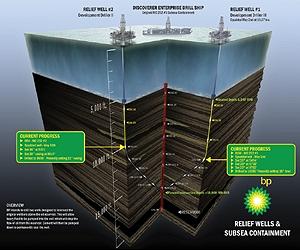
US oilspill pointman Thad Allen ordered BP Saturday to run a series of tests before continuing to drill a relief well to permanently seal the ruptured Gulf of Mexico oil well with a "bottom kill."
Delayed for a few days because of an approaching storm, drilling the relief well's last 30 meters (100 feet) and the final capping procedure are expected to take four days once the procedure gets the green light from Allen.
In a directive, the retired US Coast Guard admiral told BP Saturday the bottom kill operation would go ahead once he gives the order.
"After the results of the Post Cement Pressure Test, and in response to BP's request to consider foregoing the Relief Well, the Government Scientific Technical Team has determined that the benefits of the bottom kill procedure outweigh the risks," Allen said in the statement.
After a series of failures, BP was able to fully stem the flow of oil into the sea on July 15 with a temporary cap. The well was plugged with cement on August 5 and tests were run on the integrity of the plug.
Before drilling the relief well can resume, however, Allen asked BP to present plans for a "pressure relief system … including any necessary containment option," should excessive pressure accumulate at the well head.
He also requested a series or pressure tests "to assess the stability of the well" when the current damaged well stack is removed and replaced with a new one.
A new blowout preventer on top of the capped well would make sure oil doesn't escape if a mistake is made during the bottom kill operation.
Before the stack is removed, Allen said he wants BP to "prove to my satisfaction" that the annulus between the well pipe and the outer well bore is either leak resistant, or provide a proper risk assessment of any possible leak scenario.
About 1,000 barrels of oil are believed to be trapped in the well's annulus and it's possible that some of the cement pumped in from above effectively sealed the annulus off from the surface.
But to be sure, and reflecting the White House's consistent line that the relief well was the ultimate solution, a decision was made to continue with the bottom kill operation that will pump cement all the way to the well's source under the Gulf of Mexico.
The well ruptured when the BP-leased Deepwater Horizon rig sank on April 22, two days after a massive explosion that killed 11 workers.
At 4.9 million barrels — or enough oil to fill 311 Olympic-sized swimming pools — the disaster is the biggest maritime spill on record.
It threatened the fish and wildlife-rich US Gulf coast with environmental ruin and plunged residents of coastal communities into months of anguish over their livelihoods and the region's future.
Share This Article With Planet Earth
