
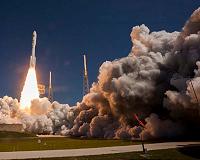
A secure communications satellite built for the US Navy has begun operational testing after reaching the proper orbit more than two months after being lifted into outer space, the manufacturer Lockheed Martin said in a press release on Friday.
On June 29, five days after being launched from Cape Canaveral Air Force Station in the US state of Florida, the Mobile User Objective System (MUOS) satellite experienced an anomaly that prevented it from reaching a high-earth orbit, the release explained.
"In the end, the Navy and Lockheed Martin engineering team were able to isolate the issue and develop a work-around using alternative propulsion," Lockheed Martin's Narrowband Communications Systems Director Mark Woempner said in the release. "Once we had a plan together, in early October we carefully re-started orbit raising maneuvers."
The latest launch was the fifth MUOS satellite, completing a network of orbs that will cover the entire globe with secure communications, the release noted. Once testing is completed, the satellite will be turned over to the Navy, the release added.
Launch of Atlas V Rocket With Weather Satellite Delayed From Mid-November
United Launch Alliance said that the latest launch date for an Atlas V rocket carrying the weather-forecasting Geostationary Operational Environmental Satellite has been postponed from November 16.
The latest launch date for an Atlas V rocket carrying the weather-forecasting Geostationary Operational Environmental Satellite (GOES-R) has been postponed from November 16, and a new date remains to be determined, the private consortium United Launch Alliance said in a press release.
"The launch of a United Launch Alliance Atlas V carrying the GOES-R weather satellite for NASA and NOAA is being rescheduled," Thursday's release stated.
"A new launch date will be released once it is established." United Launch explained that the postponement was caused by the same problem with the Atlas V booster that forced the delay of a previous mission but stressed that its team is "actively working towards a resolution."
The National Oceanic and Atmospheric Administration announced in October that a launch of the GOES-R, a next-generation satellite designed to improve scientists' ability to detect severe weather, had been delayed due to the impact of Hurricane Matthew.
The United Launch Alliance is a joint venture between aerospace giants Lockheed Martin and Boeing established to provide space-launch services for US government clients.
