
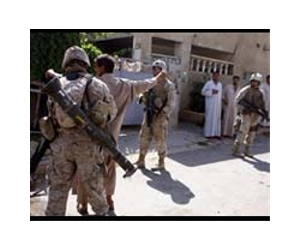
US Marines left the Sunni-dominated western province of Anbar on Saturday after almost seven years of operations in what was once Iraq's epicentre of Al-Qaeda activity and insurgent violence.
"In a significant milestone in the responsible drawdown of US forces from Iraq, one of the four division-level units is departing without replacement and Marine Corps deployments to Iraq come to an end," a US military statement said.
The marines, whose most high-profile and bloody actions in Anbar were sieges of the city of Fallujah in April and November 2004, turned over control of Anbar to Iraqi security forces in September 2008.
It was the first Sunni province to be returned to Baghdad's Shiite-led government.
Sunni Arabs in Anbar were the first to turn against US forces after the toppling of Saddam Hussein's regime by US-led invasion forces in 2003, mounting a raging insurgency that tore through the world's most sophisticated military.
In the first years after the invasion, Iraq's biggest province became the theatre of a brutal war focused on Fallujah and Ramadi, while a string of towns along the Euphrates valley became insurgent strongholds and later safe havens for Al-Qaeda.
Around one third of US fatalities, or 1,305 troops, until that time had been sustained in Anbar which borders Saudi Arabia, Jordan and Syria.
The brutal Al-Qaeda-led insurgency also killed around 6,000 civilians in the province, according to independent website Iraqbodycount.org.
earlier related report
Biden 'confident' Iraq election row will be resolved
Baghdad (AFP) Jan 23, 2010 –
US Vice President Joe Biden said on Saturday he was confident Iraq's leaders would find a "just" solution to a bitter row that has seen hundreds of candidates banned from a March 7 general election.
Biden landed in Baghdad late on Friday and used meetings with the war-torn country's leaders to assure them Washington would not interfere in the dispute which has seen both Sunni Arabs and Shiites excluded from the poll.
Analysts, however, told AFP the vice president's words had failed to conceal the trip was a "rescue mission" aimed at navigating a serious political crisis which remains unsolved.
The 511 candidates banned from taking part are accused of membership or other links to executed dictator Saddam Hussein's outlawed Baath party, feared Fedayeen (Men of Sacrifice) militia or Mukhabarat intelligence agency.
The dispute has stoked tension between the Shiite majority now leading the government and the Sunni Arab former elite and has also exposed the failings of a much vaunted but apparently stumbling national reconciliation process.
"I want to make it clear I am not here to resolve that issue," said Biden at a joint media conference with Iraqi President Jalal Talabani.
"This is for Iraqis to do, not for me. After today's discussions though I am confident that Iraq's leaders are seized with the problem and are working for a final, just solution."
Biden said the United States supported the exclusion of candidates linked to Saddam's regime but urged legitimate procedures.
"The issue is not the goal of holding individuals accountable for their past actions but the process of disqualification itself," Biden said.
"Iraqis under their leaders understand that if the people see the process as fair and transparent it will enhance the credibility of the election."
As well as Talabani, Biden met Prime Minister Nuri al-Maliki, parliament speaker Iyad al-Samarrai, the UN secretary general's special representative for Iraq, Ad Melkert, and a cross-section of other political leaders.
He also visited US troops before leaving the country, an embassy official said.
Saleh al-Mutlak, a leading Sunni MP and persistent critic of Maliki's Shiite-dominated government, is among those who have been barred from the election. Maliki denies Sunnis have been targeted ahead of the vote.
The election row sparked a flurry of contacts by Biden in recent days aimed at brokering a compromise, notably through Talabani, who is a Kurd.
Biden "proposed the disqualifications be deferred until after the election and that those candidates who have been barred condemn and disavow the Baath party," said a statement from Talabani's office earlier this week.
Joost Hiltermann, a Washington-based Iraq specialist and Middle East deputy programme director for the International Crisis Group, which studies conflict-hit nations, said Biden's trip had not gone far enough.
"Whatever the long-term planning may have been, his visit was clearly a rescue mission, certainly in the public eye, which is what counts," Hiltermann said.
"On paper, out of deference to Iraqi sovereignty and Iraqis' strong sense of national pride, he listened rather than proposing solutions.
"Suggesting that the actual barring of candidates be postponed till after the elections was good but insufficient. It could lead to a big crisis when the election results come in, especially if people allied to Mutlak amass a lot of additional 'sympathy' votes."
Reider Visser, who runs the Iraq-focused website www.historiae.org, said US leverage had always been limited "because American forces are on their way out anyway."
"At most, then, one can guess that Biden may have asked Iraqi leaders to make sure the appeals mechanisms reinstate some of the barred politicians, thereby reducing the sense of marginalisation."
Elections chief Faraj al-Haidari told AFP on Friday more candidates could yet be barred from the ballot.
While in Baghdad, Biden also announced an appeal against a US court ruling that dropped charges against the American private security firm formerly known as Blackwater, whose guards are accused of killing 14 Iraqi civilians in 2007.
Share This Article With Planet Earth
