
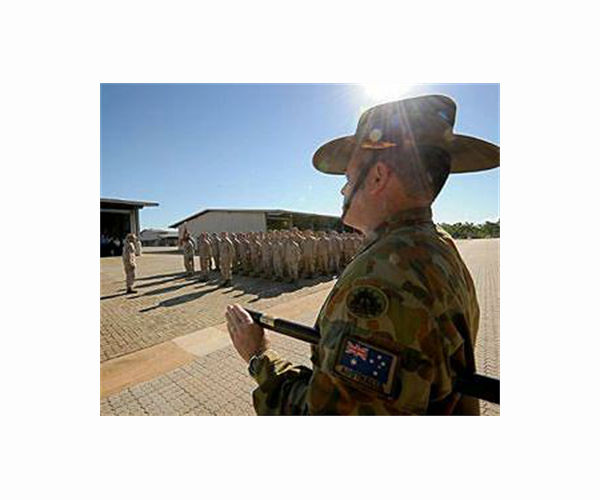
The U.S. Marine Corps and Air Force concluded a major training exercise with the Australian Defense Forces in August, the Marines announced on Friday.
The U.S. forces joined a combined task force in Australia's Northern Territory, involving four B-1B Lancers, two B-2 Spirit stealth bombers, four F-15C Eagles and about 1,200 Marines for international interoperability exercises.
The Marine Rotational Force-Darwin, which has been involved in the annual training since 2012, is now a "highly capable force that provides significant opportunities to enhance interoperability with the Australian Defense Force," a statement by the Australian Defense Department statement said.
Marines practiced target location, confirmation and damage assessment, and used an RQ-21A unmanned aerial vehicle to conduct surveillance and reconnaissance of one target. A simultaneous simulated strike was conducted with Australian Army forward air controllers in Tiger armed reconnaissance helicopters.
Air Force bombers provided air-to-ground low-pass coverage while U.S. Marines called in coordinated, rapid-air strikes, including live munitions dropped on targets in a demonstration of the B-2 Spirit's precision strike capabilities.
"It's imperative that the U.S. Marine Corps and Australian Army work together," said Australian Army Sgt. Aaron Costes, a JTAC [joint terminal attack controller] with the 102nd Coral Battery of the Royal Australian Artillery. "It's such a feat that we can infill and have an aircraft come in from such long distances."
The B-1s arrived from Andersen Air Force Base, Guam, and the B-2s, deployed from Whiteman Air Force Base in Missouri to Diego Garcia in the Indian Ocean, flew about 4,000 miles to join the proceedings. KC-135 Stratotankers of the Kadena Air Base, Japan, also flew to Darwin, Australia, to support the bomber presence.
