
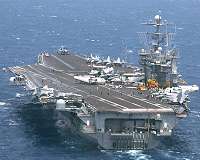
Units from the USS Harry S. Truman Carrier Strike Group will return to Norfolk, Va., on Saturday.
"The National Defense Strategy directs us to be operationally unpredictable while remaining strategically predictable. As such, select units from the USS Harry S. Truman Carrier Strike Group will return to Norfolk, Virginia, this week," commander of U.S. Fleet Forces Adm. Christopher Grady said in a Monday press release. The ship and its three escorts will return Saturday, according to the U.S. Naval Institute.
The Truman Carrier Strike Group has been deployed for three months with the US 6th Fleet. The ships were involved in striking Islamic State targets in Syria and participated in exercises with allied nations.
The ships will remain operational as part of a sustainment phase of the Optimized Fleet Response Plan. They will undergo routine maintenance, although they still could be deployed. Training rotations for sailors will also be performed.
Seven-month deployments have been standard, which makes the Truman's return unusual. It will join the USS George H.W. Bush at Norfolk for routine refits while remaining operational. The USS Abraham Lincoln will join them this fall.
U.K., Australian ministers review BAE ship construction at Glasgow shipyard
Washington (UPI) Jul 19, 2018 –
British Secretary of State for Defense MP Gavin Williamson was joined by Australian Minister of Defense Marise Payne on a tour of BAE Systems Glasgow shipyard on Thursday.
The visit concerned a discussion of the Australian SEA 5000 Future Frigates Program, and included a viewing of the new Type 26 Global Combat Ship Glasgow.
Construction of the Glasgow started about a year ago, and the visit was only days after an announcement by the Australian Government that its nine anti-submarine Hunter-class frigates will be based on the U.K.'s new Type 26 design.
The Hunter-class will be built by BAE in Australia for the Royal Australian Navy.
"Australia's selection of the Type 26 Combat Ship for its Future Frigates program reflects the world-leading anti-submarine warfare capabilities these ships will deliver to the U.K. and to the Commonwealth," Charles Woodburn, BAE's chief executive, said in a press release.
Australia's contract could be worth well over $26 billion and has been their largest naval acquisition for over ten years, according to the Australian government.
"This renaissance in British shipbuilding is great news for our major yards, but also for the whole defense industry, with millions being injected into so many businesses, both big and small, supporting and supplying our world-class warships," Williamson said.
The Type 26 supply chain has now seen investment worth over $1.3 billion, and many of the businesses involved are now perfectly placed to benefit from Australia's $26 billion, according to Williamson.
The 6,900-ton warships are designed for a number of naval missions, including anti-submarine warfare.
Saudi signs deal for five warships with Spain's Navantia
Riyadh (AFP) July 19, 2018 –
Saudi Arabia's state-owned defence company has forged a deal with Spanish shipbuilder Navantia for a joint venture to build five warships, state media said Thursday.
The agreement with Saudi Arabian Military Industries (SAMI) for the design and construction of five Avante 2200 corvettes warships will start this autumn, with the last unit to be delivered by 2022, the official Saudi Press Agency reported.
The agreement appears part of a framework agreed in April during Crown Prince Mohammed bin Salman's visit to Spain for Navantia to provide warships to the Gulf state for around two billion euros ($2.3 billion).
A coalition of NGOs including Amnesty International had urged Madrid not to go ahead with the deal because the corvettes could be used in Saudi Arabia's military campaign against Iran-backed Huthi rebels in Yemen.
Saudi Arabia has long been a major global arms importer — but some countries now refuse to sell weapons over the kingdom's role in the conflict in Yemen, gripped by what the UN calls the world's worst humanitarian crisis.
But Spain's loss-making shipbuilder Navantia appears to be banking heavily on the agreement, which has reportedly been under negotiation for years.
SAMI says it aims to become a major player in the global defence industry and localise more than half of the kingdom's military spending by 2030.
The agreement announced on Thursday will generate up to 6,000 jobs for five years, including 1,100 direct jobs, SPA reported.
Under Prince Mohammed's "Vision 2030", a package of economic and social reforms aimed at reducing dependence on oil exports, Riyadh plans to spend 32 billion euros in transportation infrastructure in the next decade.
Spanish firms have already won two major infrastructure contracts in Saudi Arabia in recent years.
A Spanish consortium, Al-Shoula, is building a high-speed railway across the desert to link the holy cities of Mecca and Medina while Spanish construction group FCC leads one of three consortia building a rapid transit system in the Saudi capital.
