
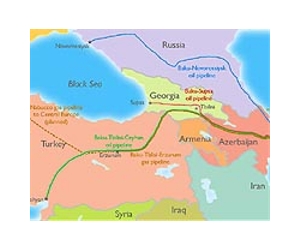
Since the 1991 collapse of the Soviet Union, Turkey has made strenuous efforts to position itself as a regional energy hub.
Its facilities have frequently been the targets of attacks, however. Two people died and one person was injured in a suspected terrorist attack about 6:30 p.m. Tuesday on the Kirkuk-Ceyhan pipeline in Turkey's Mardin region near the village of Midyat.
The Kirkuk-Ceyhan pipeline carries about a quarter of Iraq's crude exports.
A Turkish government official, speaking to the Anadolu Ajansi news agency on condition of anonymity, blamed the explosion on the outlawed militant group, the Partiya Karkeren Kurdistan — Kurdistan Workers' Party — which has battling the Turkish government since the late 1970s.
The 600-mile, 40-inch Kirkuk-Ceyhan export pipeline, built in 1970, terminates at Turkey's Dortyol port on the Mediterranean coast near Ceyhan.
The Kirkuk-Ceyhan pipeline was closed by U.N. sanctions against Saddam Hussein's regime during 1991-2003. Turkey estimated that in supporting sanctions it had lost $80 billion in transit fees.
The pipeline had a pre-invasion capacity of about 1.5 million to 1.6 million barrels per day but shipped around 800,000 bpd. Kirkuk-Ceyhan is Iraq's largest operable crude export pipeline but repeated insurgent attacks inside Iraq since 2003 have lowered its output to around 600,000 bpd. Last October a blast near Mosul halted oil supplies through the pipeline.
The crown jewel in Turkey's hydrocarbon export facilities is the $3.6 billion, 1 million bpd 1,092-mile Baku-Tbilisi-Ceyhan pipeline, which began operations in May 2005 and supplies an estimated 1 percent of global daily energy needs.
BTC transits high-quality crude from Azerbaijan's offshore Azeri-Chirag-Guneshli fields to Turkey's deep-water Mediterranean terminus at Ceyhan.
The BTC pipeline has also been attacked by the PKK. On Aug. 5, 2008 the BTC Refahiye pipeline segment at Yurtbasi village exploded, which resulted in a conflagration sending flames 160 feet into the air and halting oil flow.
After Ankara was notified, valves were closed as officials waited for the oil contained in the 4-mile segment to burn out, with BTC operator British Petroleum declaring force majeure.
The same month as the BTC attack the PKK's Abd-al-Rahman Chadarchi stated that if PKK forces in northern Iraq were attacked by units of the Turkish armed forces, his group would assault Turkish oil targets, "since they bring huge amounts of money to Turkey," adding, "The military regime in the country will use this (energy revenues) to develop its war machine to utilize it against the Kurdish people in Turkish Kurdistan."
Share This Article With Planet Earth
