
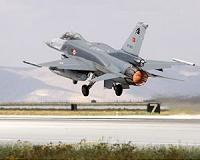
Turkey denied Friday it had suspended air strikes against Islamic State targets in Syria after the downing of a Russian warplane on the Syrian border.
Turkish F-16 jets on Tuesday shot down a Russian warplane which Ankara said had breached its air space.
The Hurriyet newspaper said Turkey, a member of a US-led coalition fighting IS, had "temporarily" halted air raids against the group in Syria in order to avoid any further crises.
"Both sides agreed to act cautiously until they re-establish dialogue channels to reduce tensions," the paper said, citing security sources.
But a government official denied that strikes had been halted.
"At this time, Turkey remains fully committed to fighting ISIS as part of the international coalition," he told AFP, using another name for the IS group.
"Our policy remains unchanged and the claims, therefore, are inaccurate.
"Turkey's participation in coalition air strikes is determined by ourselves and our allies alone depending on mutual assessments of military developments on the ground and logistical needs."
The downing of the plane sparked a crisis in relations between the two countries, with Russian President Vladimir Putin calling it a "stab in the back" and demanding an apology from the Turkish leadership.
Turkish President Recep Tayyip Erdogan has angrily rebuffed the Kremlin's demand for an apology and said Putin snubbed a phone call from him after the incident.
Erdogan on Friday said he wanted to meet with Putin on the margins of the upcoming climate summit in Paris.
Russia plane entered Israel control zone from Syria: minister
Jerusalem (AFP) Nov 29, 2015 –
A Russian warplane recently entered Israeli-controlled airspace from Syria but the intrusion was resolved without incident, Israeli Defence Minister Moshe Yaalon said on Sunday.
Yaalon's comments come amid deep concern over the downing of a Russian warplane by Turkey, which claims it strayed over the Syrian border into its airspace and ignored repeated warnings to change course. Moscow denies the allegations.
"There was a slight intrusion a mile (1.6 kilometres) deep by a Russian plane from Syria into our airspace, but it was immediately resolved and the Russian plane returned towards Syria," Yaalon told public radio.
"It was apparently an error by the pilot who was flying near the Golan."
Israel seized most of the Golan Heights from Syria in 1967 and later annexed the territory in a move never recognised by the international community.
Yaalon recalled that Israel and Russia had made arrangements to avoid clashes over Syria, with the agreement said to include a "hotline" and information sharing.
He said "Russian planes do not intend to attack us, which is why we must not automatically react and shoot them down when an error occurs."
Israeli Prime Minister Benjamin Netanyahu and Russian President Vladimir Putin held talks in Moscow in September to discuss ways of avoiding accidental clashes.
Russia launched a bombing campaign in Syria on September 30 at the request of its longstanding ally Bashar al-Assad that Moscow says is targeting Islamic State jihadists and other "terrorist" groups.
Israel has reportedly launched more than a dozen air strikes in Syria since 2013, mainly targeting alleged arms transfers to Hezbollah, and Israeli officials were believed to have feared that Russia's intervention could limit their room for manoeuvre.
Israel opposes Assad, but has sought to avoid being dragged into the war.
It also fears that Iran could increase its support for Hezbollah and other militant groups as international sanctions are gradually lifted under a July nuclear deal that Moscow helped negotiate between Tehran and world powers.
In September 2014, Israel downed a Russian-made Syrian warplane over the Golan Heights in the first such incident in three decades and warned it would respond "forcefully" if its security was threatened.
