
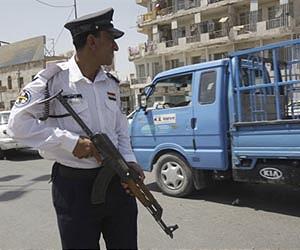
Iraqi traffic police began to arm themselves with high-powered weapons for the first time in two years as an escalation in attacks against the force saw another officer killed on Monday.
The roadside explosion at a police station in Ghazaliyah, western Baghdad, also killed a civilian and left 10 people wounded, including seven traffic policemen, officials said.
The blast brought to at least five the number of traffic policemen — who usually do not wear bullet-proof vests and carry only pistols — killed this month, with a further 27 wounded.
"It is a sick strategy that the terrorists are carrying out," said traffic police Lieutenant Ahmed Ali, working in the central Baghdad junction of Karamana Square.
"We are working to serve the people, to organise the traffic," the father of two young girls added.
"These attacks are being carried out by Al-Qaeda, which wants to target the government, and so attacks those who represent the state in an attempt to topple it."
Several traffic policemen in Baghdad have been seen carrying Kalashnikov assault rifles in recent days, in an apparent response to the attacks against the force.
Lieutenant General Ali Ghaidan Majeed, commander of Iraq's ground forces, said the country's traffic police had not been heavily armed in two years.
That period was during the country's brutal sectarian war when many traffic police wore masks while on duty so as not to reveal their identities to insurgents and fend off possible attacks.
"For the most part they are not armed so they are easy targets for the terrorists," Majeed told a press briefing in Baghdad.
"From 2005 to 2008 the traffic police were armed but after the stability we saw in Iraq we first allowed them to have just a side-arm for self defence, but now we are looking at arming them with long rifles."
The string of shootings and explosions have worsened an already severe gridlock during rush-hour in Baghdad.
According to witnesses, several traffic policemen have not been patrolling the streets at major junctions, but instead observing from behind concrete blast walls or other concealed areas.
"These officers stand under the sun from morning until evening, regulating traffic," said Razaq Mehdi, a 58-year-old motorist driving through Rasheed Street in central Baghdad.
"Targeting them is criminal and inhumane."
Also on Monday, a Kurdish money-exchange shopowner was assassinated in the disputed northern city of Kirkuk, while a roadside bomb in the central city of Baquba left one dead and four wounded, police said.
The latest violence comes after a weekend in which 60 people were killed, ahead of the start of the Muslim holy month of Ramadan when insurgents typically step up their attacks.
The unrest has fuelled concerns about security here — more than 100 people have died this month — as the United States pulls out thousands of troops from Iraq, although US officers insist Iraqi soldiers and police are up to the task.
Iraq is also grappling with a five-month-long political impasse after a March 7 parliamentary election failed to produce a clear winner, ushering in as yet fruitless coalition negotiations between the leading parties.
Prime Minister Nuri al-Maliki, fighting to keep his job after narrowly losing the election, insisted the security situation was not getting worse, "but some gaps have opened up, here and there, from time to time."
The violence comes ahead of Ramadan, expected to begin in Iraq on Wednesday or Thursday. In previous years the holy month of fasting has coincided with a spike in insurgent activity.
US forces, meanwhile, are to reduce troop levels ahead of an August 31 deadline to end combat operations, by which time there will be 50,000 American soldiers in Iraq from about 64,000 currently.
Share This Article With Planet Earth
