
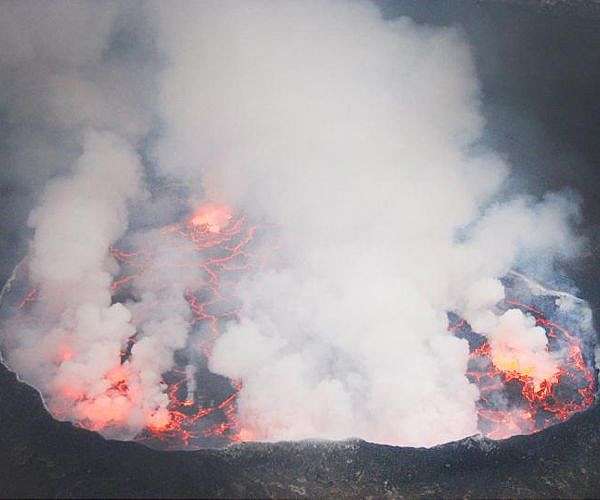
Tourists who were near the crater when the Nyiragongo volcano in the Democratic Republic Congo erupted are safe, the Congolese Institute for the Conservation of Nature (ICCN) said Sunday.
Nor were the rare mountain gorillas in the Virunga National Park threatened by the eruption, the institute added.
"The tourists present yesterday at the crater are safe and sound", the institute, which oversees the wildlife sanctuary, said on Twitter, without indicating their numbers or nationalities.
The park, inscribed on the UNESCO World Heritage list, covers 600,000 hectares (1.5 million acres) of tropical rainforest that is notably home to the world's biggest population of eastern lowland gorillas.
The Nyiragongo volcano, whose slopes dominate the city of Goma and Lake Kivu, erupted suddenly on Saturday night, sending thousands of residents fleeing in panic.
A vast river of molten lava came to a halt Sunday on the outskirts of Goma, sparing the city.
The Goma region is a zone of intense seismic activity, with six volcanos, including Nyiragongo and Nyamuragira, which rise to 3,470 and 3,058 metres (11,384 and 10,033 feet) respectively.
Eruptions are frequent, not just from the craters but from the sides of the volcanos.
DR Congo volcano lava flow halts in suburbs of Goma: AFP correspondent
Goma, Dr Congo (AFP) May 23, 2021 –
The flaming, red-glowing lava pouring out of a volcano that erupted in the Democratic Republic of Congo on Sunday appears to have halted after reaching the suburbs of the city of Goma, according to an AFP correspondent at the scene.
Thousands of people fled when Mount Nyiragongo erupted during the night sending the still-unstable molten rock on a path to the eastern city.
Officials said the lava had reached Goma city airport — located on the outskirts of the metropolis on the shores of Lake Kivu — although residents said it had stopped at the edge of the facility.
Around a dozen earth tremors were felt in Goma in the early morning.
"People are beginning to return to their homes. The situation seems to have calmed down for the moment," one resident said.
"But people are still scared. The authorities still haven't made any official announcement so far this morning," he added.
The last time Nyiragongo erupted was January 17, 2002, killing more than a hundred people and covering almost all of the eastern part of Goma with lava, including half of the airport's landing strip.
During that eruption, the victims were mostly sick or elderly abandoned to their fate in the northern districts of the city with some looting also taking place.
Thousands flee DR Congo volcano for neighbouring Rwanda
Kigali (AFP) May 23, 2021 –
At least 3,000 people have fled an eastern city in the Democratic Republic of Congo for Rwanda on Sunday after the eruption of Mount Nyiragongo.
The government ordered an evacuation after the volcano, which overlooks the regional capital city Goma, began erupting Saturday.
"At least 3,000 people from Goma, in DRC, have already crossed to Rwanda," the public broadcaster the Rwanda Broadcast Agency tweeted citing the latest figures from Rwanda immigration authorities at the Rwanda-DRC border.
The account also tweeted photos of people arriving in Rubavu district in Rwanda, adding that they would be "accommodated in schools and places of worship that have been made ready".
Rwanda's ambassador to the DR Congo Vincent Karega tweeted that "the borders are open and our neighbours are being welcomed peacefully".
The lava reached the DRC city's airport early Sunday, with an official from Virunga National Park — where the volcano is located — telling his staff: "the situation is deteriorating".
Earlier, as the volcano began lighting up a smell of sulfur pervaded Goma city on the shores of Lake Kivu, according to an AFP correspondent.
The regional capital of North Kivu, Goma has nearly 600,000 inhabitants, spread across 12 districts.
The authorities' evacuation plan anticipates that two-thirds of them will go to Rwanda.
The previous major eruption of Nyiragongo dates back to January 17, 2002, and killed more than 100 people, covering almost the entire eastern part of Goma with lava, including half of the airport runway.
