
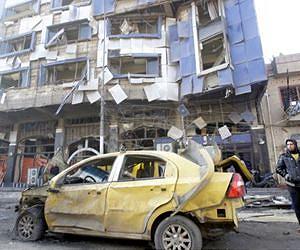
A wave of attacks mostly targeting security forces in Sunni areas of Iraq killed at least 73 people, officials said on Tuesday, updating the toll from the violence a day earlier.
Monday's unrest, which wounded more than 250 people, is the latest in a surge in bloodshed that, along with a long-running political stalemate, has stoked fears of a return of the all-out sectarian war in Iraq in 2006 and 2007.
It also shattered hopes a recent series of symbolic political gestures had managed to ease tensions.
No group immediately claimed responsibility for the bloodshed, but Sunni militants linked to Al-Qaeda have in the past launched coordinated nationwide bombings in a bid to undermine confidence in the security forces and the Shiite-led authorities.
They have also targeted fellow Sunnis, ostensibly in a bid to provoke retributive violence against Shiite Muslims.
The Islamic State of Iraq, Al-Qaeda's front group in the country, views Shiites as apostates.
The deadliest violence on Monday hit the predominantly-Sunni Arab city of Mosul, with a series of five car bombings mostly targeting security forces killing at least 29 and wounding 80 others, officials said.
Meanwhile, attacks near Saddam Hussein's birthplace of Owja, the town of Dour and in Taji — all predominantly Sunni areas — killed a further 13 people.
And 12 more people died in violence in the northern province of Kirkuk and the nearby towns of Tuz Khurmatu and Suleiman Bek.
The towns, which have mixed Sunni Arab, Kurdish and Turkmen populations, are seen as a tinderbox because they are part of a swathe of territory claimed by the central government and the autonomous Kurdish region.
Blasts in the confessionally-mixed town of Madain and Shiite neighbourhoods of Baghdad killed six more people, while three near-simultaneous bombings in a mostly-Shiite town in restive Diyala province killed 13.
The unrest comes amid a surge in attacks in Iraq, with violence in May pushing the month's death toll to its highest level since 2008, raising concerns of a revival of the all-out sectarian war that blighted the country in 2006 and 2007.
There has been a heightened level of attacks since the beginning of the year, coinciding with rising discontent among the Sunni Arab minority that erupted into protests in late December.
The outgoing UN envoy to Iraq Martin Kobler has warned the violence is "ready to explode".
UN chief appeals for dialogue, reconciliation in Iraq
United Nations (AFP) June 11, 2013 –
UN Secretary General Ban Ki-moon appealed Tuesday for dialogue and greater efforts at "national reconciliation" in Iraq after a wave of deadly attacks.
Ban "underscores the pressing need for dialogue between political blocs in order to overcome the current crisis," his spokesman Martin Nesirky said.
He said the UN chief was concerned about "the escalating political tensions and the appalling upsurge of violence that has killed a high number of civilians over the last two months."
"He urges all parties to redouble their efforts to ensure that the momentum of national reconciliation is not lost to those groups that strive to reignite sectarian violence in Iraq," Nesirky added.
On Tuesday, three members of Iraq's security forces, including two senior officers, were killed. A day earlier, 78 people lost their lives and more than 250 were wounded in bombings and shootings.
No group has claimed responsibility for the latest violence, but Sunni militants linked to Al-Qaeda have in the past launched coordinated nationwide bombings in a bid to undermine confidence in the security forces and the Shiite-led authorities.
