
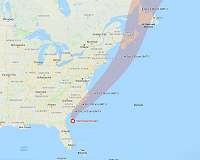
Deserted streets, boarded-up shops, closed museums: the touristic town of Charleston, a historical and architectural gem in the southeastern United States, is already feeling the financial bite of Hurricane Dorian.
After devastating the Bahamas, where it killed at least 20 people, and appearing to have largely spared Florida, US states farther north are preparing to take a hit from the high winds and surging waters of the weakened but still-dangerous Category 2 hurricane.
The tourists "are gone. It's brutal," said Brian Solari, the 44-year-old owner of Carmella's waterfront cafe in the French Quarter, estimating there has been a "probably 50 percent loss in sales."
Solari blamed the "ridiculous mandatory evacuation" ordered by the government ahead of the storm, which has not yet arrived in city, a popular tourist destination of cobblestone streets and pastel-hued houses that was once at the heart of the slave trade.
His cafe is the only one open for several streets around and inhabitants who have not evacuated have found refuge here.
"We're gonna be open into the evening. People expect us to be open. Locals appreciate that we're open," Solari said.
Leaning on the cafe's wide counter, 26-year-old Michael Stracy said the Mills House hotel, where he is food and beverage manager, had suffered "thousands of dollars of loss."
"We had about 150 people coming this week and they had to cancel," Stracy said. "This whole city will lose tons of money."
He and his wife plan to spend the night in one of the few hotels that is still open — and operating at a reduced rate — because their own neighborhood is particularly prone to flooding.
– 'Just the locals' –
In Folly Beach, a small seaside town located south of Charleston, some residents — among them Kaycee Meyer, 29 — are ignoring evacuation orders.
The school teacher likes the sudden peace and quiet of this town of 2,400, which is usually bustling in summer as surfers pour in.
"It's kind of cool staying here. Nobody is there and it's just the locals that are out in bars. Walking out last night on the beach there was barely anyone there. It's kind of a cool experience," said Meyer.
She is staying with her boyfriend, George Hubbard, 41, whose small house is very close to the beach and its crashing waves, which are getting bigger and bigger.
"So far so good," Hubbard said.
Hubbard, who runs a now deserted parking lot and rents golf carts and bikes, said that — like people in Charleston — the storm is really hurting him financially.
This would normally be a profitable late summer week for him. But all around are empty hotels and homes.
– 'Coming together' –
"I don't think the winds are going to be too bad," said Hubbard although he acknowledges he and Meyer might move further inland later in the day.
"If it was a Category 5 we would be gone," said Hubbard, who has long hair, a big smile and a vodka cocktail in his hand.
Another Folly Beach resident, Pat Hiban, calmly walks his dog along an empty road with big, deep puddles. It is raining hard.
Hiban, 53, does not want to leave, either. He says his wife is sick of false alarms. They have lived here for five years and endured a fair number of storms.
"When I bought the house, we didn't know it would come every year like this," said Hiban.
Last year, for instance, they left to avoid Hurricane Florence, and "nothing happened."
This time they stocked up on food and supplies and "charged up everything."
If they get bored, they can always go to one of the few bars in Folly Beach that have stayed open despite the approaching storm.
"This is the fun part about hurricanes!," said Meyer. "Coming together."
U.S. military installations, bases brace for Hurricane Dorian
Washington (UPI) Sep 4, 2019 –
Military installations along the U.S. Southeast coast completed preparations and evacuations ahead of Hurricane Dorian on Wednesday.
The hurricane was rated at Category 5 when it struck the Bahamas and then diminished, bringing heavy rain and wind, as it slowly moved westward toward Florida, Georgia, South Carolina and North Carolina.
Navy ships based at Naval Station Norfolk and Joint Expeditionary Base Little Creek in Virginia left their bases beginning on Monday evening, and will remain at sea until the storm subsides. Aircraft was either secured in hangars or flown to alternate airfields, and non-essential personnel were allowed to leave their posts and evacuate the region.
"Based on the current track of the storm, we made the decision to begin to sortie our Hampton Roads-based ships and aircraft [in Virginia]," said Vice Adm. Andrew Lewis, commander, U.S. 2nd Fleet, on Wednesday. "This allows time for our assets to transit safely out of the path of the storm."
"Personnel at bases along the Atlantic Coast spent the weekend constructing and installing sandbags, removing hazards and debris from drainage areas, removing large items from waterfront areas, ensuring emergency generators and vehicles are topped off with fuel, and filling and preparing potable water supplies," a Navy statement said.
Over the weekend the Naval Nuclear Power Training Command in Charleston, S.C., began shutting down its operations, prior to a general evacuation by Tuesday evening. The Naval Submarine Base in Kings Bay, Ga., and Naval Station Mayport, Fla., shut down their operations ahead of the storm.
The U.S. Marine Corps moved up graduation ceremonies at Parris Island, S.C., and ordered active-duty personnel and dependents to evacuate, as did the nearby Marine Corps Air Station Beaufort. Amphibious assault ships conducting training off the coast of North Carolina remained at sea and prepared to provide potential disaster relief, officials said.
On Monday, the U.S. Coast Guard began its involvement in medical evacuations in the Bahamas, supporting the Bahamian National Emergency Management Agency and the Royal Bahamian Defense Force. Helicopters of Coast Guard Air Station Clearwater, Fla., forward-deployed to Andros Island in the Bahamas before the storm made landfall.
Maxwell AFB, Ala., used mainly for training purposes, opened as a supply center to receive trailers of food, water and other supplies sent by FEMA to aid residents affected by the hurricane. It also received evacuated helicopters moved from Naval Station Jacksonville in Florida.
"As we have for the last several hurricane seasons, the 42nd Air Base Wing and Maxwell Air Force Base are ready to support whole-of-government efforts to provide Americans emergency relief," said Col. Patrick Carley, 42nd Air Base Wing commander. "Maxwell is a prime location to provide emergency relief support and a safe haven location during severe weather."
Preparation for military evacuations began on Friday.
MacDill AFB, near Tampa, flew 16 to 18 of its fleet of 24 KC-135 Stratotankers to McConnell AFB in Kansas to wait out the storm. The massive planes are used to refuel aircraft in midair, and will return to Florida when conditions return to normal.
Ships and aircraft started departing from Mayport and Naval Air Station Jacksonville before Hurricane Dorian moved closer to the coast.
