
The clues to our evolutionary ancestors? They're in our genes. All organisms carry patterns in their DNA that scientists can analyze to decipher where and when a species diverged on the evolutionary tree. These studies can reveal how a particular species evolved to become the organism we know today.
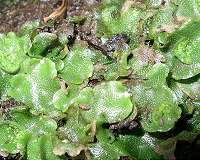
In collaboration with over 40 universities and research institutes worldwide, Takayuki Kohchi and colleagues at Kyoto University have unraveled the genome of the common liverwort – Marchantia polymorpha – gaining new insight into how the modest land plants evolved. The results were published recently in the journal Cell.
"All land plants, from moss on rocks to trees that flower, evolved from a common ancestral algal species that colonized land about 500 million years ago," explains Kohchi.
"The liverwort diverged from other land plants at the earliest stage of evolution, and therefore still possess ancestral characteristics of plant species that followed."
Liverworts have been used extensively in plant research since they were first studied in the late Middle Ages. In the past few years, Kohchi and his colleagues had developed various molecular and genetic techniques that opened the door to improved analysis, especially for the study of plant genetics.
Using these techniques, the team deciphered the liverwort's roughly 20,000 genes, discovering in part the low level of genetic redundancy that controls the plant's development and physiology.
"Flowering plants have redundant copies of vital genes in their DNA, so that if something goes wrong, there's a backup," continues Kohchi. "And while liverworts have the fundamental ancestral versions of basic mechanisms to keep plants alive, these are exceedingly simple."
Based on these findings, the scientific significance of the lowly liverwort is now unassailable: it is a key model plant for molecular and genetic studies, providing hints to future agricultural applications and plant breeding technologies.
"Now that we know the liverwort genome, we can begin to decipher the functions of each individual gene, and how these evolved in later plant species," concludes Kohchi.
Bandit-masked feathered dinosaur hid from predators using multiple types of camouflage
Researchers from the University of Bristol have revealed how a small feathered dinosaur used its colour patterning, including a bandit mask-like stripe across its eyes, to avoid being detected by its predators and prey.
By reconstructing the likely colour patterning of the Chinese dinosaur Sinosauropteryx, researchers have shown that it had multiple types of camouflage which likely helped … read more
