
Since 2018, a new style of research has been introduced in gamma-ray-bursts (GRBs) studies: it does not describe the prompt radiation phase observed by the Neil Gehrels Swift Observatory and the NASA Fermi Gamma-ray Space Telescope by a time-integrated spectral analysis, typically applied to long GRBs and obtaining a Band spectrum with various fitting parameters, this procedure, as recognized by David Band, does not permit a taxonomy of GRBs [1].
The approach followed by the ICRANet group, developing the binary driven hypernova (BdHN) model of long GRBs, focuses only on luminous GRBs with a large signal to noise ratio which allow to proceed to a time-resolved analysis.
In doing so three main events in the prompt radiation phase have been identified [2]: 1) the supernova rise, 2) the moment of formation of a black hole coinciding with the onset of the GeV radiation and 3) the emission of a cavity, created by the explosion of electron-positron plasma in the expanding supernova ejecta, see Fig. 1.
In addition to these results, the greatest novelty in this field has been so far the discovery of self-similarity and power laws in the data, following the black hole formation from 1.9 second to 3.9 seconds, see the accompanying article [2], leading to evidence of quantized versus continuous emission in the GeV radiation, see the accompanying article [3].
The new study, co-authored by R. Ruffini, J. D. Melon Fuksman, G. V. Vereshchagin [4], was published 3 October 2019 in the Astrophysical Journal. It presents the evidence of the formation of a cavity in the source of gamma-ray burst GRB 190114C. It is proposed that this GRB originates in a binary system composed of a massive carbon-oxygen core, described within the binary-driven hypernova I (BdHN I) scenario.
In this scenario, the carbon-oxygen core undergoes a supernova explosion with the creation of a new neutron star, and then hypercritical accretion occurs onto the companion binary neutron star until it exceeds the critical mass for gravitational collapse.
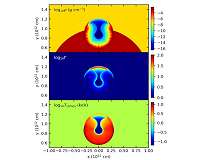
It is shown that the formation of a black hole captures 10^57 baryons by enclosing them within its horizon, and thus a cavity of approximately 10^11 cm is formed around it with initial density 10^-7 g/cm^3. A further depletion of baryons in the cavity originates from the expansion of the electron-positron-photon plasma formed at the moment of the collapse, reaching a density of 10^-14 g/cm^3 by the end of the interaction. It is demonstrated, using an analytical model complemented by a hydrodynamic numerical simulation, see Fig. 2, that part of the electron-positron-photon plasma is reflected off the walls of the cavity.
The consequent outflow and its observed properties are shown to coincide with the featureless emission occurring in a time interval of duration, measured in the rest frame of the source, between 11 and 20 seconds of the GBM observation.
Moreover, similar features of the GRB light curve were previously observed in GRB 090926A and GRB 130427A, all belonging to the BdHN I class. These results support the general framework presented in [2] and guarantees that a low baryon density is reached in the cavity, a necessary condition for the operation of the "inner engine" of the GRB, presented in the accompanying article [3].
The density of 10^-14 g/cm^3 here discovered points clearly to a completely different origin of the MeV and GeV emission hosted in the cavity: an electromagnetic machine, producing emission very close to the black hole horizon, and based on three components: 1) a Kerr black hole, 2) a uniform magnetic field following the Papapetrou theorem and 3) a low density plasma of 10^-14 g/cm^3 [4].
This contrasts with the traditional gravitational accretion of very high density matter onto a black hole. This result profoundly changes the traditional mechanism of emission of GRBs and can be extended to active galactic nuclei (AGNs) [5]. As a consequence, also the physics of GRBs afterglows has been modified avoiding the ultrarelativistic blast wave emission and utilizing the synchrotron process occurring around the new neutron star expected in the BdHN model [6].
