
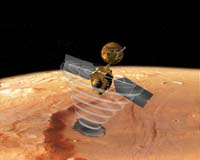
The radar sounder SHARAD of the NASA mission Mars Reconnaissance Orbiter has provided images of the Mars North Pole stratigraphy.
This is the beginning of the article "Mars North Polar Deposits: Stratigraphy, Age and Geodynamical Response", published Friday on Science and prepared by a team of Italian and USA scientists, among which the radar scientific responsible, Dr. Roberto Seu, a scientist of the INFOCOM Department of La Sapienza University (Rome).
The article analyzes the data of SHARAD, a Italian radar provided by Italian Space Agency (ASI).
The radar, initially conceived by the team of Prof Giovanni Picardi, INFOCOM Department, has been realized in cooperation with the Italian main industry in space field, Thales Alenia Space Italia, showing that ASI, university and industry could cooperate and obtain excellence results together.
Its features allow to "watch", using radio frequencies, even under an optical unfathomable surface. Between geologists and planetologists there is a common idea that the north pole of Mars is the result of 3 billions of years of sedimentations and ice erosion never deeply observed before. SHARAD is able to "watch" inside its composition for several hundreds of meters in depth.
"The layers are mainly shaped from ice and powders mixtures, in different fractions. The analysis of these layers has given various and important results, which have allowed to get better the knowledge of Mars climatology and so the variations of the obliquity and the orbital eccentricity of the planet that could had cycles long about millions of years," Dr. Seu says.
Moreover, from the observation of the rocky layer deflexion, on which ice and powder layers are positioned and caused from its weight, it has been possible to esteem the mantle viscosity and so the warmth production more in deepth.
In particular it has been verified that the Mars lithosphere could be larger than we thought some years ago. It means that the conditions finding water in liquid form and so the conditions for each life form should stay deeper than we thought some years ago.
SHARAD has been working since the beginning of November 2006 and the planning of observation and data elaboration has been realized by young contractor engineers with the INFOCOM Department in a centre developed on behalf of ASI at Thales Alenia Space in Rome, with the scientific supervision of Dr. Seu.
"The quantity and the quality of the onboard instruments observations, and in particular of SHARAD, overcome all expectations and are convincing NASA to approve the extension of the mission till the end of 2010," Dr. E. Flamini, the ASI responsible for the program, says. Together with SHARAD, another Italian radar sounder, is working around Mars, on board of the European probe Mars Express: MARSIS, with Prof. Giovanni Picardi as principal investigator.
These two radars are complementary about the deep observation under the surface and the capability of underline thin layers.
