
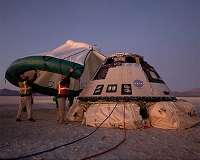
The Starliner, known as CST-100, is a crew space transportation capsule manufactured by Boeing for NASA's Commercial Crew Development (CCDev) program. Its primary purpose is to transport crews to low-Earth orbit destinations such as the International Space Station (ISS) and the proposed Bigelow Aerospace Commercial Space Station.
This capsule is 15 feet in diameter, as compared to the slightly-smaller Apollo Command Module and slightly-larger Orion capsule. Reportedly, the Starliner can accommodate crews of up to seven people for up to seven months and is reusable for up to 10 missions. The interfaces are compatible with several launch vehicles, including the Atlas V, Falcon 9 and Vulcan.
Between 2010 and 2012, NASA provided Boeing with funds in excess of $570 million in support of Starliner development. In 2014, NASA selected both the Starliner and SpaceX's Crew Dragon for the Commercial Crew Transportation Capability (CCtCap) program. The total award for this program was $4.2 billion.
Most recently, Boeing launched an uncrewed test flight of a Starliner on an Atlas V, on December 20, 2019 from Cape Canaveral, Florida. Although the capsule safely returned to Earth on the next day, the Starliner experienced a propulsion anomaly that prevented a planned docking with the ISS.
The mission plan was to rendezvous with the ISS, deliver cargo and return safely. Reports indicate that the Atlas V performed normally, but the capsule was prevented from reaching the ISS due to a capsule flight-control system misfire of its propulsion system.
Nevertheless, the CST-100 did reach an orbit from which it later reentered the atmosphere and landed at the intended touchdown site. The apparent cause of the anomaly was an error in the mission elapsed timing system which is crucial to telling the spacecraft's computers when and how to fire its thrusters to reach the correct orbit. In a crewed flight this kind of anomaly could have been avoided by manual control techniques.
