
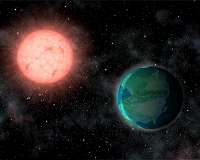
Scientists have developed a new method for detecting oxygen in exoplanet atmospheres that may accelerate the search for life.
One possible indication of life, or biosignature, is the presence of oxygen in an exoplanet's atmosphere. Oxygen is generated by life on Earth when organisms such as plants, algae, and cyanobacteria use photosynthesis to convert sunlight into chemical energy.
UC Riverside helped develop the new technique, which will use NASA's James Webb Space Telescope to detect a strong signal that oxygen molecules produce when they collide. This signal could help scientists distinguish between living and nonliving planets.
Since exoplanets, which orbit stars other than our Sun, are so far away, scientists cannot look for signs of life by visiting these distant worlds. Instead, they must use a cutting-edge telescope like Webb to see what's inside the atmospheres of exoplanets.
"Before our work, oxygen at similar levels as on Earth was thought to be undetectable with Webb," said Thomas Fauchez of NASA's Goddard Space Flight Center and lead author of the study. "This oxygen signal is known since the early 1980s from Earth's atmospheric studies but has never been studied for exoplanet research."
UC Riverside astrobiologist Edward Schwieterman originally proposed a similar way of detecting high concentrations of oxygen from nonliving processes and was a member of the team that developed this technique. Their work was published in the journal Nature Astronomy and presented at the 235th meeting of the American Astronomical Society in Honolulu, Hawaii.
"Oxygen is one of the most exciting molecules to detect because of its link with life, but we don't know if life is the only cause of oxygen in an atmosphere," Schwieterman said. "This technique will allow us to find oxygen in planets both living and dead."
