
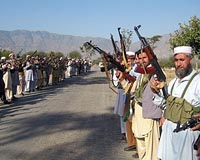
Pakistan may be claiming early successes but Taliban guerrillas who confound the military time and again are likely to defy the army's pledge to write them off, outsmarting them in their homeland.
After eight days of painstaking advance, siege and bombing, the military hailed the first major gain of its latest ground offensive — the capture of Kotkai, the home town of Pakistan Taliban chief Hakimullah Mehsud.
Troops overran Kotkai, in South Waziristan, on two previous occasions only to retreat after signing the kind of peace deals that Western critics have savaged for granting sanctuary to Al-Qaeda-linked militants.
Witnesses among the more than 120,000 civilians displaced by the conflict speak of heavy bombing and long-distance artillery, tactics that maximise collateral damage and undercut modern counter-insurgency doctrine.
While the army says more than 160 militants and 23 troops have been killed, it is impossible to assess the advance, resistance or casualties — civilian or otherwise — because the area is cut off to journalists and aid workers.
Washington, which has grown increasingly alarmed at the security situation in nuclear-armed Pakistan, has praised the operation whose progress is likely to feature heavily in a looming visit by Secretary of State Hillary Clinton.
Regional envoy Richard Holbrooke said the United States was "very impressed with the Pakistani resolve" but cautioned it was too early to assess.
"We know where the troops are going; they're in the early phase. But it'll take a while before we know whether the enemy they're fighting has been dispersed or destroyed or some mixture of the two," he told reporters.
In an early acknowledgement of difficulties, commanders said the offensive, originally earmarked for six to eight weeks, could drag into the desperately cold winter because of landmines and the forbidding terrain.
Security officials say troops are advancing carefully, capturing strategic heights and roads, guarding their rear and protecting their flanks but that the Taliban have yet to mount stiff resistance.
One official complained of poor intelligence leaving commanders unclear on Taliban tactics or strength, with assessments ranging from 5,000 to 15,000.
"Troops have very little information about the number of militants and their strategy," he told AFP.
Out of Pakistan's military strength of 600,000, barely 30,000 troops are deployed in South Waziristan and 150,000 in the entire northwest, the New America Foundation think tank wrote before the latest offensive began.
The organisation believes Pakistan needs 370,000 to 430,000 more troops in the tribal belt and northwest to meet the force-to-population ratio of counter-insurgency doctrine and even that does not guarantee success.
Rushed into the assault after a spike of attacks embarrassed security forces, the start of ground operations has not silenced the militants. Bombers struck an Islamabad university campus, targeting an airbase and a restaurant.
"The Taliban will try to expand the war and keep the army busy in more than one place, but the question is whether they succeed or not," Rahimullah Yusufzai, one of Pakistan's most prominent experts on tribal affairs, told AFP.
"They want their allies to attack in North Waziristan. There have already been attacks in Bajaur and Mohmand. They will try to hit back in Swat," he said, referring to the valley where the army fought the Taliban this year.
"Taliban are also targeting major cities to create more fear and to put pressure on government," Yusufzai said.
Militant networks are sophisticated. Tehreek-e-Taliban Pakistan, the army's enemy in South Waziristan, is loosely affiliated to Al-Qaeda and linked to sectarian radicals elsewhere along the Afghan border and southern Punjab.
With nearly 200 people killed in attacks so far this month alone, schools have been closed and nervous families are steering clear of markets and restaurants.
An article on the Foreign Policy website said the militants were likely to attack civilian targets and drag the military into a guerrilla war.
"Anyone who has studied guerrilla war will tell you that armies fighting militant organisations go, for lack of a better term, a little crazy.
"They don't know where the next attack is coming from, they become suspicious of everything, trust dies and they start acting in stupid and counter-productive ways," it said.
earlier related report
US Congress approves new restrictions on Pakistan aid
US lawmakers on Thursday passed a giant Pentagon spending bill that sets tough new restrictions on military aid to Pakistan, where top officials are already fuming over previous limits.
The move came as Pakistani troops fought through the sixth day of a major assault against Taliban fighters in the restive Afghan border region with officials saying 137 militants and 18 soldiers had been killed since Saturday.
The US Senate voted 68-29 in favor of a 680-billion-dollar defense spending bill for fiscal year 2010, which sailed through the House of Representatives by a 281-146 margin on October 8 and now goes to President Barack Obama.
The new limits include efforts to track where US military hardware sent to Pakistan ends up, as well as a warning that US aid to Pakistan must not upset "the balance of power in the region" — a reference to tensions with India.
The measure's chief authors, Senators Robert Menendez and Bob Corker, praised Pakistan for its help routing extremists but said they wanted to be sure US military aid goes to fight the "war on terrorism."
"That fight is important to our own national security, and we have to ensure that our support for it is not being squandered or diverted," said Menendez, a Democrat from New Jersey.
"The Pakistanis should be commended for working to eliminate the terrorist safe havens within their own borders and for their role in the broader war on violent extremism," said Corker, a Republican from Tennessee.
"This provision simply ensures that the American peoples' tax dollars are being used for their intended purpose," he said.
But the vote could worsen a flare-up between Washington and Islamabad about strings attached to US dollars, military training, and hardware, with Pakistani officials bitterly complaining of US interference in domestic affairs.
Officials in Islamabad have condemned restrictions in US legislation to triple non-military aid to 7.5 billion dollars over five years, denouncing some limits the package sets on security assistance as attacks on its sovereignty.
But US lawmakers have increasingly called for closer tracking of US aid to Pakistan, amid growing concerns about US strategy in Afghanistan as Obama weighs sending more troops to fight the eight-year-told war.
The military spending bill would impose new restrictions on how Pakistan gets reimbursed out of a 1.6-billion-dollar fund for logistical and military support of US-led efforts to battle Islamist insurgents.
The measure requires that the US secretaries of state and defense certify that "whether such reimbursement is consistent with the national security interest of the United States and will not adversely impact the balance of power in the region."
The bill also says the Pentagon must certify that Islamabad is waging a "concerted" fight against Al-Qaeda, the Taliban, and other fighters before it can receive the massive package of aid to battle extremists on its soil.
It directs the Pentagon to track how Pakistan uses military hardware it receives in order "to prohibit the re-transfer of such defense articles and defense services without the consent of the United States."
The legislation instructs the White House to send lawmakers a report every 180 days on progress toward long-term security and stability in Pakistan.
The bill also, for the first time, makes it a federal crime to assault gays because of their sexual orientation, adding them to the list of groups protected under "hate crimes" legislation.
The measure, long a priority of the late Democratic senator Edward Kennedy, prohibits assaults based on a person's race, color, religion, national origin, gender, sexual orientation, gender identity, or mental or physical disability.
The spending bill also calls for spending another 130 billion dollars on the wars in Iraq and Afghanistan in fiscal year 2010, which began October 1.
Share This Article With Planet Earth
