
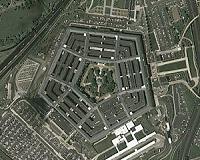
The Pentagon said Tuesday it would respond "as necessary" if there were violations of a cessation of hostilities agreement in Syria, warning it was a "test" for Russia.
Pentagon press secretary Peter Cook would not specify the nature of the response, but said a failure to abide by the agreement reached in Munich would be factored into US military decision-making.
"We will be keeping a close eye on who abides by it and who does not, and we will be in a position to say clearly, and to respond if necessary, if there are violations of that cessation of hostilities," Cook said at a Pentagon briefing.
The warning follows air strikes in and around Aleppo on Monday that hit hospitals and schools, killing an estimated 50 people, according to the United Nations, which called the attacks a "blatant violation of international law."
Neither the United Nations nor the United States have directly accused Moscow of carrying out those air strikes, but the State Department said Monday the attacks cast doubt on Russia's willingness or ability to stop the fighting.
Russian bombers have been supporting a Syrian government offensive on Aleppo, and Moscow is Syrian President Bashar al-Assad's closest ally.
"This is a test for the Russians," said Cook, calling the cessation of hostilities agreement reached in Munich Friday "a new marker, a new line if you will for Russia and others to abide by. We are signatories to it as well."
The agreement to halt the fighting and allow humanitarian relief to reach besieged Syrian cities was supposed to go into effect within a week.
The State Department, however, played down expectations it would take hold by then.
"I can't say categorically that a week from last Thursday there must be a cessation of hostilities, but certainly we're going to expect that there is progress," deputy State Department spokesman Mark Toner told reporters.
"I'm not trying to excuse the delay in any way, shape or form. I think we're going to continue to pursue aggressively, the cessation of hostilities. But we also recognize we need, the parties involved need a little space in order to at least make the effort," he said.
Cook had mentioned a March 1 date for the cessation of hostilities to go into effect, but then backpedaled, saying he may have misspoken and referring reporters to the State Department.
Syria's UN envoy blasts MSF over hospital attack
United Nations, United States (AFP) Feb 16, 2016 –
Syria's UN envoy on Tuesday accused the medical aid charity MSF of being a front for French intelligence in Syria and dismissed allegations that Russian air strikes had destroyed one of its hospitals.
"The so-called hospital was installed without any prior consultation with the Syrian government by the so-called French network called MSF which is a branch of the French intelligence operating in Syria," said Ambassador Bashar Jaafari.
Doctors Without Borders (MSF) said at least 11 people were killed after the hospital in Idlib province was destroyed on Monday morning, but it did not assign blame for the attack.
"They assume the full consequences of the act because they did not consult with the Syrian government," Jaafari told reporters.
"They did not operate with the Syrian government permission."
He repeated Syrian claims that the US-led coalition had carried out the air strikes that hit the MSF-backed hospital.
French Ambassador Francois Delattre slammed the Syrian ambassador for his "revolting remarks" which he said "showed once again his true face."
The Syrian ambassador spoke following a UN Security Council meeting called by Russia to discuss Turkey's military action against Kurdish fighters in northern Syria.
