
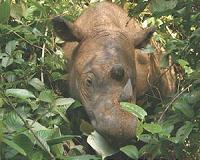
A critically endangered Sumatran rhino has died weeks after its chance discovery on the Indonesian part of Borneo island was hailed as a landmark conservation success, an official said Tuesday.
The rare rhino was caught in a pit trap last month in East Kalimantan province in an area close to mining operations and plantations, where it was struggling to survive.
It was the first physical contact environmentalists had made with a Sumatran rhino on Indonesian Borneo in more than 40 years, after it was assumed the animal was long extinct.
However Najaq, as the female rhino was known, succumbed to a leg infection after her health deteriorated in recent days, Indonesia's environment ministry confirmed.
"The death of this Sumatran rhino proves they exist on Borneo, so we will continue protecting them," Tachrir Fathoni, a senior official at the environment ministry, told AFP.
A post-mortem examination is being conducted to determine the official cause of death, he added.
Environmentalists discovered in 2013 that the Sumatran rhino was not extinct on Indonesian Borneo — as had long been thought — when hidden cameras captured images of the animals.
Conservationists had heralded the capture of the rhino in March as an exciting discovery, and expressed disappointment at the tragic turn of events.
"This is a very valuable lesson that shows saving a rhino can be very difficult, and needs the support of experts," said WWF Indonesia head Efransjah, who like many Indonesians goes by one name.
There were once Sumatran rhinos all over Borneo but their numbers have dwindled dramatically, with poaching and the expansion of mining and plantation operations considered the main reasons for the decline.
The Sumatran rhino is the only Asian rhino with two horns, and are covered with long hair. It's estimated there are less than 100 left in the wild.
Wild elephant kills five in India's northeast
New Delhi (AFP) April 5, 2016 –
A rampaging elephant killed five members of a family including a nine-day old infant in a remote village in India's northeastern frontier, a local official said Tuesday.
The elephant trampled the family to death while they were asleep in their thatched hut in the early hours of Tuesday in Behali forest, some 256 kilometres (160 miles) from Assam state's capital Guwahati.
Both parents, their infant daughter and two other children died during the incident, while their three-year-old daughter survived the attack and was being treated at a hospital for minor injuries.
"The family was asleep when the elephant attacked their hut," Rajiv Chaudhary, a divisional forestry officer, told AFP.
He said the elephant had apparently strayed from its herd when it charged the home. The animal reportedly left the area soon after the attack, according to the official.
Wildlife experts say encounters between humans and elephants are increasing in India's rural areas due to the destruction of the animals' habitat.
Last month a herd of wild elephants went on an hours-long rampage in neighbouring West Bengal, killing five people and damaging vehicles and homes before being subdued with tranquilliser darts.
