
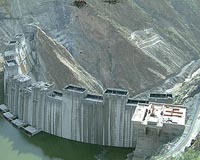
Sudan on Tuesday rejected an Ethiopian proposal to sign an initial agreement greenlighting the filling of a controversial mega-dam it is building.
"I cannot accept the signing of a draft agreement to the first phase (filling the dam) because it poses legal and technical problems that must be addressed," Sudanese Prime Minister Abdalla Hamdok said in a statement.
Ethiopian Prime Minister Abiy Ahmed had urged him to sign the agreement.
Both Khartoum and Cairo fear the dam will trap their essential water supplies once the giant reservoir starts being filled in July as planned by Addis Ababa.
Hamed Saleh, Sudan's chief negotiator in talks on the dam facilitated by the US administration, said "most of the issues at play… cannot be separated… including long-term environmental and social impacts".
Tensions have been high in the Nile basin ever since Ethiopia broke ground on the project in 2011.
Addis Ababa says the dam is crucial for its economy, while Egypt fears it will disrupt the river that provides almost all its water.
Sudan hopes the dam will provide much-needed electricity and help regulate flooding.
The US Treasury Department and the World Bank stepped in as observers last year to facilitate talks between the three countries after negotiations repeatedly failed.
"The only way to reach a comprehensive agreement is for all parties to go back to the negotiating table immediately," Hamdok added.
The 6,600-kilometre-long (3,900-mile) Nile is a lifeline supplying both water and electricity to the 10 countries it traverses.
Its main tributaries, the White and Blue Niles, converge in the Sudanese capital Khartoum before flowing north through Egypt to drain into the Mediterranean Sea.
Laos to press ahead with 'destructive' new dam on Mekong
Bangkok (AFP) May 12, 2020 –
Environmentalists have criticised Laos for pressing ahead with plans for another "destructive dam" on the Mekong River, a waterway already strangled by hydropower schemes.
The flow of the Mekong, Southeast Asia's longest river, is interrupted by a cascade of dams in China — where it is called the Lancang.
Two downstream dams — the Xayaburi and Don Sahong — have been built in Laos, which wants to construct seven more as it strives to live up to its billing as the "Battery of Asia".
Water levels have dropped to record lows over the last year, exposing rocks and killing fish, a phenomenon blamed by villagers in Thailand and Laos on the operations of dams.
On Monday, Laos' communist government submitted proposals for the Sanakham dam — close to the northeastern border with Thailand — to the Mekong River Commission (MRC).
The MRC is a dam consultation body for Mekong nations, but has been accused of being toothless in stopping river projects sponsored by governments and big business.
The consultation process is in fact a "rubber stamp" to get work started on the Sanakham this year in time for a 2028 completion, according to International Rivers, a key campaign group against damming.
"What the Mekong needs immediately is the moratorium on large-scale hydropower dams… not more destructive dams that will benefit a few at the expense of communities in the Mekong basin," Paiporn Deetes of International Rivers told AFP.
The MRC says the Sanakham dam consultation includes an environmental impact assessment on the waterway and its communities.
Landlocked, corrupt and poor, Laos has turned to billion-dollar hydropower schemes for investment, hoping to sell the electricity for a profit to its neighbours as well as provide energy to its remote populations.
But critics say dams have been railroaded through despite mounting evidence of ecological damage to one of the world's most biodiverse waterways.
Villagers along the Mekong in Laos and Thailand say their fish catch has dwindled as the dams have come online.
Studies show sediment flow has thinned, leaving the river increasingly anaemic as it winds towards the Vietnamese delta.
The Mekong feeds around 60 million people.
