
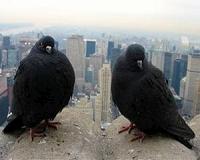
City life demands a more aggressive disposition — for humans and for bids. The same goes for suburban life.
A new study found birds living among suburban environs exhibit higher levels of territorial aggression than their peers from the country. The closer to the city, the angrier the birds.
"A possible reason for this is that these birds have less space but better resources to defend," Scott Davies, a biological sciences postdoctoral associate at Virginia Tech, said in a news release. "Living near humans provides better food and shelter, but it also means more competition for these limited resources."
Researchers measured levels of territorial aggression among song sparrows at rural and urban sites in southwestern Virginia's New River Valley. The campuses of Virginia Tech and Radford University served as suburban sites, while rural birds were observed on country farms and in parks.
All of the observed birds responded to the song of an intruder, but suburban birds responded more quickly and aggressively.
Researchers aren't yet sure what exactly explains the difference in disposition, but say understanding the effects of urbanization on animals is important for the future of wildlife management, as populations and cities grow.
"Predicting the impact that human population growth will have on wildlife requires studying the species that adjust and persist in human-impacted habitats," said Kendra Sewall, an assistant professor of biological sciences at Virginia Tech.
"Suburban sprawl is a primary form of human habitat change and though many species can survive in our backyards, their behavior and physiology may change to cope with shifts in resources and with new disturbances."
Ducklings aren't just cute, they're surprisingly smart
Oxford, England (UPI) Jul 14, 2016 –
New research reveals ducklings are surprisingly intelligent. According to scientist at Oxford University, newborn ducks quickly learn the concepts of "same" and "different."
Researchers took advantage of a period known as imprinting, when ducklings identify and follow their mother. As long as they can see during the "sensitive period for imprinting," ducklings can learn to follow any moving object.
Scientists showed ducklings several pairs of moving objects. Some pairs were identical, while others featured a difference of either color or shape.
Researchers then tested the ducklings' ability to follow the correct pair of objects, given a choice between a pair similar to the initial pair, or an entirely different pair.
For example, a duckling imprinted with a pair of yellow squares might be shown a pair of white circles and a pair comprised of one red triangle and one green square.
Scientists hypothesized that a duckling who was imprinted with an identical pair of objects would prefer a pair that exhibits the concept of sameness. They'd go for the two white circles.
And in the experiment, they did. Ducklings who were imprinted with a contrasting pair would prefer another contrasting pair.
Previously, only highly intelligent animals like apes and ravens were thought to understand the concepts of same and different.
"And because imprinting happens so quickly, the ducklings learned to discriminate relational concepts much faster than other species, and with a similar level of precision," Alex Kacelnik, a zoologist at Oxford University, said in a news release.
"While it seems surprising at first that these one-day-old ducklings can learn something that normally only very intelligent species can do, it also makes biological sense," said Antone Martinho, a doctoral student in Oxford's zoology department.
"When a duckling is young, it needs to be able to stay near its mother for protection, and an error in identifying her could be fatal.
Ducks' varied lifestyle — walking, flying, swimming — ensures their perspective is constantly changing.
"They need to be able to flexibly and reliably identify her, and a library of concepts and characteristics describing her is a much more efficient way to do so, compared with a visual memory of every possible configuration of the mother and her environment," Martinho said.
